Asian countries gain prominence in science and technology as US loses ground
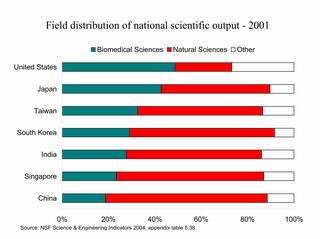
The global landscape for science and technology is changing, with increased competition for resources and recognition. That's beginning to look like bad news for the innovative edge the United States has long enjoyed.
"Will the United States own the technology of the future? Probably not all of it, and only if we compete harder to maintain our current position," said Diana Hicks, professor and chair of Georgia Institute of Technology's School of Public Policy.
Many foreign governments have been strengthening their educational and research programs, she explained. As a result, the gap is closing between the United States and its overseas competitors, with Asian countries – China, South Korea, Japan, Taiwan, Singapore and India -- showing particular gains.
Hicks will discuss trends in Asian research and development and their impact on U.S. education and industry on March 14 at the American Chemical Society's 229th national meeting in San Diego, Calif. Speaking at the symposium "Chemistry Enterprise 2015: Where in the World Will We Be? The Big Picture," Hicks will present a number of benchmarks that raise concern for the United States. Bigger talent pool: The number of researchers in Asia has grown rapidly as more Asians, especially the Chinese, earn doctoral degrees. At the same time, the number of U.S. citizens pursuing doctoral degrees has been decreasing.
In addition, the number of Asian students who study for doctoral degrees in the United States dropped 19 percent in just four years, 1994 to 1998. That's disturbing because those students had helped make up for the dearth of U.S.-born students enrolled in science and engineering, Hicks explained. Foreign students often remain in the United States for research jobs, contributing to the nation's knowledge base.
Increased R&D spending: From 1995 through 2001, China, South Korea and Taiwan increased gross R&D spending by about 140 percent, while the United States increased its investments by only 34 percent.
Another disturbing signpost: 68 percent of all domestic R&D money in the United States now comes from the private sector. Nearly three-fourths of this money goes toward development instead of basic research (in which researchers try to gain greater knowledge of a subject without specific applications in mind).
"Basic research is important because it sets up the country for the next generation of technology so we don't run out of innovations," Hicks said. "Funding basic research is the role of the public sector, and yet federal spending for basic research in engineering and the physical sciences has shown little or no growth in the last 30 years."
Patent growth: Since 1988, the number of U.S. patent applications for innovations originating in Asia increased 789 percent, with South Korea evidencing especially strong gains. In contrast, U.S. patent applications for homegrown technology grew more slowly at a rate of 116 percent.
Published papers: The United States' share of science and engineering papers published worldwide fell from 38 percent in 1988 to 31 percent in 2001, while European and Asian papers have been on the upswing. In fact, Western Europe, which evidenced a 36 percent share in 2001, now one-ups the United States. During the 1988-2001 period, Asia's share of published papers grew from 11 to 17 percent.
Although scientific papers don't always have immediate commercial applications, they remain an important measure of our knowledge base, Hicks said. "It's a sign that you have highly skilled people who are producing the necessary knowledge for later applications," she added.
When it comes to collaborating on papers for scientific journals, the United States traditionally has been the go-to country. Yet Asian countries are beginning to collaborate more among themselves. "This makes the United States appear slightly less important – another sign that our dominance is starting to decline," Hicks said.
Granted, these benchmarks are relative, reflecting percentage growth rather than absolute numbers. Yet in the late 1990s, the actual number of published papers from U.S. researchers also began to wane, which is startling, Hicks said.
"The number of pages in journals like Nature or Science can only grow so fast," she explained. "If Asian and European nations increase their scientific capability faster, they crowd out some of our efforts, which reduces the perceived achievement of younger U.S. scientists. Although U.S. researchers will work far harder than previous generations, they will not command the same dominating position in world science as did their predecessors."
A member of the Task Force on the Future of American Innovation, Hicks spoke recently in Washington, D.C., where the coalition of business and academic leaders called for increased federal spending for basic research. She will make another presentation in Washington on April 5 at the 3rd annual Engineering R&D Symposium, sponsored by the United Engineering Foundation and several other industry groups.
"In contrast to natural disasters like the recent tsunami, this is a slow-developing trend, and one that's hard to see from inside the United States," Hicks said. "We're still a very competitive country, but it's important to look at the long-range implications of these benchmarks. Maintaining our leadership role in science and innovation is critical to economic strength and national security."
Source: Georgia Institute of Technology


