Researchers find evidence of dark energy in our galactic neighborhood
Astrophysicists in recent years have found evidence for a force they call dark energy in observations from the farthest reaches of the universe, billions of light years away.
Now an international team of researchers has used data from powerful computer models, supported by observations from the Hubble Space Telescope, to find evidence of dark energy right in our own cosmic neighborhood.
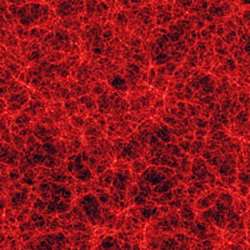
Image: A supercomputer-produced cross-section of part of the universe shows galaxies as brighter dots along filaments of matter, with a sea of dark energy filling in between the galactic islands. (Credit James Wadsley, McMaster University, Hamilton, Ontario)
The data paint a picture of the universe as a virtual sea of dark energy, with billions of galaxies as islands emerging from the sea, said Fabio Governato, a University of Washington research associate professor of astronomy and a researcher with Italy's National Institute for Astrophysics.
In 1929 astronomer Edwin Hubble demonstrated that galaxies are moving away from each other, which supported the theory that the universe has been expanding since the big bang. In 1999 cosmologists reported evidence that an unusual force, called dark energy, was actually causing the expansion of the universe to accelerate.
However, the expansion is slower than it would be otherwise because of the tug of gravity among galaxies. As the battle between the attraction of gravity and the repellent force of dark energy plays out, cosmologists are left to ponder whether the expansion will continue forever or if the universe will collapse in a "big crunch."
In 1997, Governato designed a computer model to simulate evolution of the universe from the big bang until the present. His research group found the model could not duplicate the smooth expansion that had been observed among galaxies around the Milky Way, the galaxy in which Earth resides. In fact, the model produced deviations from a purely radial expansion that were three to seven times higher than astronomers had actually observed, Governato said.
"The observed motion was small, and we could not duplicate it without the presence of dark energy," he said. "When we added the dark energy, we got a perfect match."
Governato is one of three authors of a paper describing the work, scheduled for publication in the Monthly Notices of the Royal Astronomical Society, an astronomy journal in the United Kingdom. Co-authors are Andrea Maccio of the University of Zurich in Switzerland and Cathy Horellou of Chalmers University of Technology in Sweden. The work was supported by grants from the National Science Foundation and Vetenskapsrеdet, the Swedish Research Council.
The authors, part of an international research collaboration called the N-Body Shop that originated at the UW, ran simulations of universe expansion on powerful supercomputers in Italy and Alaska. Their findings provide supporting evidence for a sea of dark energy surrounding galaxies.
"We studied the properties of galaxies close to the Milky Way instead of looking billions of light years away," Governato said. "It's like traveling from Seattle to Portland, Ore., rather than from Seattle to New York, to measure the Earth's curvature."
Source: University of Washington


