CeBIT 2005: 'Wearable Hub' for Communications in the Home
March 16, 2005
CeBIT 2005: 'Wearable Hub' for Communications in the Home

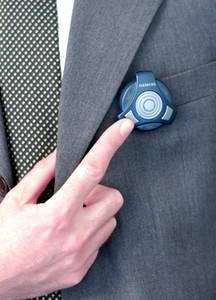
The day isn’t far off when it will be possible to control all home communications and automation systems by using a single wearable device that recognizes voice commands. Siemens developed such a small multi-talented communications device. It can be worn like a badge or pin on an article of clothing. The commands are transmitted via the Bluetooth short-range digital radio standard to a central home communications server. The server is equipped with voice recognition software, which converts the words into unambiguous commands for the hooked-up systems.

The user activates the “badge” with the push of a button and can then issue voice commands from any place in the home. A user can, for example, control the intercom system of a house or apartment and communicate with a visitor standing at the front door. Via voice command, the user can instruct the master locking system to open the door. The device can also be used to accept telephone calls and conduct phone conversations over a loudspeaker. A connection with an e-mail inbox on a PC is also envisioned. The voice recognition software reads incoming e-mails and uses a computerized voice to recite an e-mail’s text content to the user.

And there’s even a second variant of the communications wonder that’s worn around the neck. Both of the devices can replace a headset, which can become uncomfortable to wear on an everyday basis. Siemens developed a special acoustic design that makes it possible to place a device’s microphone and speaker close to each other without causing disturbing echo effects. And the design gives the integrated speaker a tone that can be clearly understood.

The server’s voice recognition software was developed by Siemens researchers in Munich and is already being successfully used in the SX1 cell phone. The program is user-independent; i.e. it doesn’t have to be “trained” to recognize the user’s voice. It can recognize 30,000 words, and predefined commands can be spoken. What’s more, the software also recognizes semantically linked words from longer sentences.

In the dealers’ pavilion at CeBIT, Siemens Communications is presenting several functions of the devices, which are still in the testing stage. Visitors can use a voice command to turn a lamp on and off, for example, or to open and close a door.

4.2 /5 (6 votes)  

Rank 4.2 /5 (6 votes)
Tags

Relevant PhysicsForums posts

More news stories

Google to make home entertainment system: report

Google will mirror Apple's winning hardware-software formula with an Android-powered entertainment system that wirelessly streams content through homes, the Wall Street Journal reported on Thursday.

Electronics / Consumer & Gadgets

created 5 hours ago | popularity 4.5 / 5 (2) | comments 0

Apple to debut 'iPad 3' in March: report

Apple will unveil a new version of its market-ruling iPad table computer in March, according to a report in Dow Jones-owned technology blog All Things D.

Electronics / Consumer & Gadgets

created 12 hours ago | popularity 2.1 / 5 (18) | comments 0

New Kindle Touch is an impressive e-reader

When it comes to reading digital books, tablets are all the rage. But there's a lot to like about simple e-readers, which over the past year have become both a lot cheaper and a lot less clunky.

Electronics / Consumer & Gadgets

created 11 hours ago | popularity 5 / 5 (2) | comments 1

Barriers fall between TV, Internet

You say TV, I say Internet. Toe-mate-o, toe-mah-to.

Electronics / Consumer & Gadgets

created 8 hours ago | popularity not rated yet | comments 0

Google rumored to have built Heads-Up-Display glasses prototype

(PhysOrg.com) -- 9to5Google is reporting that they have received a tip from someone they believe to be a reliable source saying that Google is working on a Heads-Up-Display (HUD) pair of eye-glasses. The per ...

Electronics / Consumer & Gadgets

created Feb 08, 2012 | popularity 4.3 / 5 (8) | comments 2 | with audio podcast weblog


'Dark plasmons' transmit energy

Microscopic channels of gold nanoparticles have the ability to transmit electromagnetic energy that starts as light and propagates via "dark plasmons," according to researchers at Rice University.

Hydrogen from acidic water: Researchers develop potential low cost alternative to platinum for splitting water

A technique for creating a new molecule that structurally and chemically replicates the active part of the widely used industrial catalyst molybdenite has been developed by researchers with the Lawrence Berkeley ...

FDA-approved drug rapidly clears amyloid from the brain, reverses Alzheimer's symptoms in mice

Neuroscientists at Case Western Reserve University School of Medicine have made a dramatic breakthrough in their efforts to find a cure for Alzheimer's disease. The researchers' findings, published in the journal Science, show t ...

Ultraviolet protection molecule in plants yields its secrets

Lying around in the sun all day is hazardous not just for humans but also for plants, which have no means of escape. Ultraviolet (UV) radiation from the sun can damage proteins and DNA inside cells, leading ...

Anyone can learn to be more inventive, cognitive researcher says

There will always be a wild and unpredictable quality to creativity and invention, says Anthony McCaffrey, a cognitive psychology researcher at the University of Massachusetts Amherst, because an "Aha moment" is rare and ...

Cell biologists describes mechanism by which some people may be more susceptible to colon cancer

An international research team led by cell biologists at the University of California, Riverside has uncovered a new insight into colon cancer, the third leading cause of cancer-related deaths in the United ...