New machines could turn homes into small factories
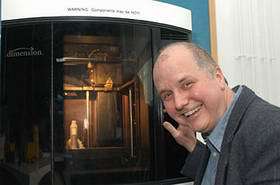
A revolutionary machine which can make everything from a cup to a clarinet quickly and cheaply could be in all our homes in the next few years.
Research by engineers at the University of Bath could transform the manufacture of almost all everyday household objects by allowing people to produce them in their own homes at the cost of a few pounds.
The new system is based upon rapid prototype machines, which are now used to produce plastic components for industry such as vehicle parts. The method they use, in which plastic is laid down in designs produced in 3D on computers, could be adapted to make many household items.
Image: Dr Andrian Bowyer from the University of Bath with the rapid prototyping machine.
However, conventional rapid prototype machines cost around £25,000 to buy. But the latest idea, by Dr Adrian Bowyer, of the University’s Centre for Biomimetics, is that these machines should begin making copies of themselves. These can be used to make further copies of themselves until there are so many machines that they become cheap enough for people to buy and use in their homes.
Dr Bowyer is working on creating the 3D models needed for a rapid prototype machine to make a copy of itself. When this is complete, he will put these on a website so that all owners of an existing conventional machine can download them for free and begin making copies of his machine. The new copies can then be sold to other people, who can in turn copy the machine and sell on.
As the number of the self-replicating machines – there are now thousands of conventional rapid prototype machines – grows rapidly, so the price will fall from £25,000 to a few hundred pounds.
“People have been talking for years about the cost of these machines dropping to be about the same as a computer printer,” said Dr Bowyer. “But it hasn’t happened. Maybe my idea will allow this to occur.”
A machine could, for instance, make a complete set of plates, dishes and bowls out of plastic, coloured and decorated to a design. It could also make metal objects out of a special alloy that melts at low temperatures, making it suitable for use in printed circuit boards for electronics.
The machines would not be able to produce glass items or complex parts such as microchips, or objects that would work under intense heat, such as toasters. But a digital camera could be made for a few pounds, and a lens and computer chip bought separately and added later. The rapid prototype machines would be useful for producing items that are now expensive, such as small musical instruments.
The items produced could be from a few millimetres (0.25 inches) to 300 millimetres (12 inches) in length, width and height. Larger items could be made simply by clipping together parts of this size.
Dr Bowyer said all that would be needed for a machine owner would be to buy the plastic and low-temperature alloy for a few pounds, and items could then be created in a few minutes or a few hours depending on their size. Designs for items could be bought – or downloaded free – from the web. Alternatively, people could create them for themselves on their own PCs.
He said that he would publish the 3D designs and computer code for the machine to replicate itself on the web over the next four years as they are developed, until the entire machine could be copied.
He said that he has not taken out a patent and will not charge for creating the design for the machine. “The most interesting part of this is that we’re going to give it away,” he said.
“At the moment an industrial company consists of hundreds of people building and making things. If these machines take off, it will give individual people the chance to do this themselves, and we are talking about making a lot of our consumer goods – the effect this has on industry and society could be dramatic.”
The machines would be about the size of a refrigerator, and would self-reproduce by making a copy of themselves, part by part. These parts would then have to be assembled manually by their owners.
Dr Bowyer said the machines were a form of Universal Constructor, first proposed theoretically by the mathematician John von Neumann in the 1950s. He also said their progress would be similar to that of a species in nature – as the machines replicated, so their users would vary them to suit their needs, some making larger objects, some more accurate devices and some making devices more quickly.
Dr Bowyer, and his colleague Ed Sells, have already created a demonstration robot with an electrical circuit built in using this technology and funding from the Nuffield Foundation. They hope to get new funding soon to begin work on the other stages of development.
Source: University of Bath


