Why colonize the Moon before going to Mars?
by Trudy E. Bell, Dr. Tony Phillips
NASA has a new Vision for Space Exploration: in the decades ahead, humans will land on Mars and explore the red planet. Brief visits will lead to longer stays and, maybe one day, to colonies.
First, though, we're returning to the Moon.
Why the Moon before Mars?
"The Moon is a natural first step," explains Philip Metzger, a physicist at NASA Kennedy Space Center. "It's nearby. We can practice living, working and doing science there before taking longer and riskier trips to Mars."
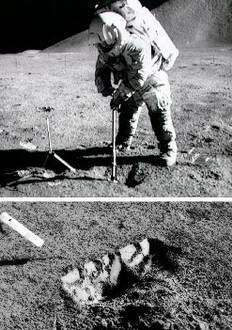
Image: An Apollo 17 astronaut digs a trench to study the mechanical behavior of moondust.
The Moon and Mars have a lot in common. The Moon has only one-sixth Earth's gravity; Mars has one-third. The Moon has no atmosphere; the Martian atmosphere is highly rarefied. The Moon can get very cold, as low as -240o C in shadows; Mars varies between -20o and -100o C.
Even more important, both planets are covered with silt-fine dust, called "regolith." The Moon's regolith was created by the ceaseless bombardment of micrometeorites, cosmic rays and particles of solar wind breaking down rocks for billions of years. Martian regolith resulted from the impacts of more massive meteorites and even asteroids, plus ages of daily erosion from water and wind. There are places on both worlds where the regolith is 10+ meters deep.
Operating mechanical equipment in the presence of so much dust is a formidable challenge. Just last month, Metzger co-chaired a meeting on the topic: "Granular Materials in Lunar and Martian Exploration," held at the Kennedy Space Center. Participants grappled with issues ranging from basic transportation ("What kind of tires does a Mars buggy need?") to mining ("How deep can you dig before the hole collapses?") to dust storms--both natural and artificial ("How much dust will a landing rocket kick up?").
Answering these questions on Earth isn't easy. Moondust and Mars dust is so ... alien.
Try this: Run your finger across the screen of your computer. You'll get a little residue of dust clinging to your fingertip. It's soft and fuzzy--that's Earth dust.
Lunar dust is different: "It's almost like fragments of glass or coral--odd shapes that are very sharp and interlocking," says Metzger.
"Even after short moon walks, Apollo 17 astronauts found dust particles had jammed the shoulder joints of their spacesuits," says Masami Nakagawa, associate professor in the mining engineering department of the Colorado School of Mines. "Moondust penetrated into seals, causing the spacesuits to leak some air pressure."
In sunlit areas, adds Nakagawa, fine dust levitated above the Apollo astronauts' knees and even above their heads, because individual particles were electrostatically charged by the Sun's ultraviolet light. Such dust particles, when tracked into the astronauts' habitat where they would become airborne, irritated their eyes and lungs. "It's a potentially serious problem."
Dust is also ubiquitous on Mars, although Mars dust is probably not as sharp as moondust. Weathering smooths the edges. Nevertheless, Martian duststorms whip these particles 50 m/s (100+ mph), scouring and wearing every exposed surface. As the rovers Spirit and Opportunity have revealed, Mars dust (like moondust) is probably electrically charged. It clings to solar panels, blocks sunlight and reduces the amount of power that can be generated for a surface mission.
For these reasons, NASA is funding Nakagawa's Project Dust, a four-year study dedicated to finding ways of mitigating the effects of dust on robotic and human exploration, ranging from designs of air filters to thin-film coatings that repel dust from spacesuits and machinery.
The Moon is also a good testing ground for what mission planners call "in-situ resource utilization" (ISRU)--a.k.a. "living off the land." Astronauts on Mars are going to want to mine certain raw materials locally: oxygen for breathing, water for drinking and rocket fuel (essentially hydrogen and oxygen) for the journey home. "We can try this on the Moon first," says Metzger.
Both the Moon and Mars are thought to harbor water frozen in the ground. The evidence for this is indirect. NASA and ESA spacecraft have detected hydrogen--presumably the H in H2O--in Martian soil. Putative icy deposits range from the Martian poles almost to the equator. Lunar ice, on the other hand, is localized near the Moon's north and south poles deep inside craters where the Sun never shines, according to similar data from Lunar Prospector and Clementine, two spacecraft that mapped the Moon in the mid-1990s.
If this ice could be excavated, thawed out and broken apart into hydrogen and oxygen ... Voila! Instant supplies. NASA's Lunar Reconnaissance Orbiter, due to launch in 2008, will use modern sensors to search for deposits and pinpoint possible mining sites.
"The lunar poles are a cold place, so we've been working with people who specialize in cold places to figure out how to land on the soils and dig into the permafrost to excavate water," Metzger says. Prime among NASA's partners are investigators from the Army Corps of Engineers' Cold Regions Research and Engineering Laboratory (CRREL). Key challenges include ways of landing rockets or building habitats on ice-rich soils without having their heat melt the ground so it collapses under their weight.
Testing all this technology on the Moon, which is only 2 or 3 days away from Earth, is going to be much easier than testing it on Mars, six months away.
So ... to Mars! But first, the Moon.
Source: Science@NASA (by Trudy E. Bell, Dr. Tony Phillips)


