Left-right brain mystery - trail is hot and cold
March 22, 2005
Left-right brain mystery - trail is hot and cold

ANU researchers have developed a new device that could potentially unravel the mysteries of the left and right brain by measuring ear temperature.
The device, which may also have medical applications, offers scientists a cost-effective way of testing which side of the brain is active when performing different tasks. Scientists know that, depending on what kind of work the brain is doing, one side is likely to be more active - broadly speaking, language skills, for example, are handled by the left side of the brain and spatial questions are dealt with in the right - but brain scans can be an expensive research tool.

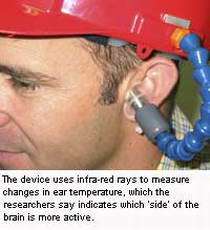
The new device, developed by psychologists Mr Nicolas Cherbuin and Dr Cobie Brinkman, measures the temperature inside a subject’s ears to work out which side of the brain is busier.

“If an area of the brain is more active it needs more blood, which flows up the carotid artery on either side of neck,” Mr Cherbuin said. “This blood is shared between the brain and the inner ear, so by measuring the ear temperature we can work out which side of the brain is more active.

“Because the blood flowing to the brain is cooler than blood already in the brain, a decrease in ear temperature indicates increased blood flow and therefore increased activity on that side of the brain.”

The test, which uses highly sensitive infra red detectors placed in the ear, was developed using two tasks, one that is known to be handled by the left side of the brain (a language task involving rhyming words) and another that scientists know is carried out on the right (which involved mentally constructing three-dimensional cubes after seeing an ‘unfolded’ two-dimensional one).

Minute fluctuations (of less than 0.1 degree) in ear temperature were found to be a highly effective indicator of brain activity.

While magnetic resonance imaging (MRI) machines can cost hundreds of thousands of dollars and scans can cost $1,000 or more per subject, the new ANU device is likely only to involve an upfront cost of roughly $5,000.

The device has potential to help unravel the mysteries of left- and right-brained people; popular theories about which are based largely on untested extrapolation of the idea that one side is holistic while the other is analytical, Mr Cherbuin said.

“Everything points to people often having one side that is more active than the other, but it may not be as clear cut as simply saying someone is left-brained or right-brained,” he added.

Future research applications include working out which side of the brain allocates attention — deciding what to concentrate on from the multitude of stimuli to which we are subjected — and working with stroke victims, who have lost brain function on one side.

The research has been announced to coincide with Brain Awareness Week.

Source: The Australian National University


Rank not rated yet
Tags

Related Stories
Relevant PhysicsForums posts

More news stories

Employers feel no love for unscrupulous practice of 'service sweethearting'

A new study led by two Florida State University marketing professors finds that some frontline service employees who are rewarded for hikes in customer loyalty and satisfaction also may engage in "service ...

Other Sciences / Economics & Business

created 5 hours ago | popularity 4 / 5 (1) | comments 4

A frank discussion of the power law and linking correlation to causation

(PhysOrg.com) -- Michael Stumpf a mathematics professor at Imperial College in London, and Mason Porter a lecturer at Oxford have teamed together to write and publish a perspective piece in Science regarding the in ...

Other Sciences / Mathematics

created 11 hours ago | popularity 5 / 5 (2) | comments 2 | with audio podcast report

The question of life in the ancient world

There’s a general feeling that we don’t get the Greeks – ancient or modern. Many, including heads of state like Angela Merkel, visibly shake their head in exasperation, rightly or wrongly, at ...

Other Sciences / Archaeology & Fossils

created 11 hours ago | popularity 1 / 5 (1) | comments 4

Sonic Cradle lands spot in TED exhibition

A Simon Fraser University graduate student project that melds music, meditation and modern technology has landed a rare spot as an exhibit at TEDActive 2012 in Palm Springs, California this month.

Other Sciences / Other

created 7 hours ago | popularity not rated yet | comments 0

Chilean miners' rescue capsule on show in London

The capsule used to rescue Chilean miners trapped underground for two months goes on display Saturday at the Science Museum in London -- the first time it has been seen in Europe.

Other Sciences / Other

created 10 hours ago | popularity not rated yet | comments 0


Google users warned of threat to smartphone wallets

Users of Google smartphone wallets were being warned on Friday that there is a way to crack pass codes intended to thwart thieves from going on illicit shopping sprees.

Anonymous knocks CIA website offline (Update)

The website of the Central Intelligence Agency was inaccessible on Friday after the hacker group Anonymous claimed to have knocked it offline.

Complex wiring of the nervous system may rely on a just a handful of genes and proteins

Researchers at the Salk Institute have discovered a startling feature of early brain development that helps to explain how complex neuron wiring patterns are programmed using just a handful of critical genes. ...

NASA sees wide-eyed cyclone Jasmine

Cyclone Jasmine's eye has opened wider on NASA satellite imagery, as it moves through the Southern Pacific Ocean.

NASA sees Giovanna reach cyclone strength, threaten Madagascar

Tropical Storm 12S built up steam and became a cyclone on February 10, 2012 as NASA's Terra satellite passed overhead. Residents of east-central Madagascar should prepare for this cyclone to make landfall ...

Putting the squeeze on planets outside our solar system

(PhysOrg.com) -- Using high-powered lasers, scientists at Lawrence Livermore National Laboratory and collaborators discovered that molten magnesium silicate undergoes a phase change in the liquid state, abruptly ...