Snake-like robot conquers obstacles

March 22, 2005
Snake-like robot conquers obstacles

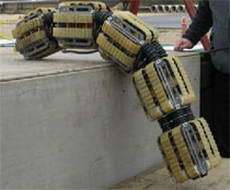
A virtually unstoppable "snakebot" developed by a University of Michigan team that resembles a high-tech slinky as it climbs pipes and stairs, rolls over rough terrain and spans wide gaps to reach the other side.
The 26-pound robot developed at the University of Michigan U-M College of Engineering is, called OmniTread. It moves by rolling, log-style, or by lifting its head or tail, inchworm-like, and muscling itself forward. The robot's unique tread design prevents it from stalling on rough ground, said Research Professor Johann Borenstein, the head of the mobile robotics lab at U-M.

The snake-shaped serpentine robot is propelled along by moving treads that cover 80 percent of its body. These treads prevent the snakebot from stalling or becoming stuck on rough terrain because, similar to a tire touching a road, t the treads propel the robot forward like a tire touching a road. Historically, scientists haven't had much success with wheeled and tracked robots on rough terrain because they constantly stall.

A human operator controls the snakebot via a joystick and umbilical cord, which also provides electric power, which sends commands to specially designed software. A smaller, but more self-contained version that is now under development will carry on - board power for one hour of tetherless operation

The OmniTread is divided into five box-shaped segments connected through the middle by a long drive shaft spine that drives the tracks of all segments. Bellow s in the joints connecting the sections inflate or deflate to make the robot turn or lift the segments. The bellows provide enough torque for the OmniTread to lift the two front or rear segments to climb objects.
Snake-like robot conquers obstacles 2
In one test, the OmniTread climbed an 18-inch curb, which is over more than twice its height. It also crossed a 66 centimeter trench, which is half its length. In another test, it inched up a pipe by pushing against opposite walls.

The robot is ideal for hazardous inspections or surveillance in industrial or military applications Borenstein said. The research was to appear in the appears on the March 18 edition of the International Journal on Industrial Robots, in a special issue on mobile robots. The paper, "The OmniTread Serpentine Robot for Industrial Inspection and Surveillance, " was written by Borenstein and co-authors Malik Hansen and Grzegorz Granosik.

For a web video of OmniTread, see, and click on video clip: http://www.engin.u … MoRob_6.html

Source: University of Michigan

3.6 /5 (22 votes)  

Rank 3.6 /5 (22 votes)
Tags

Relevant PhysicsForums posts

More news stories

Apple to debut 'iPad 3' in March: report

Apple will unveil a new version of its market-ruling iPad table computer in March, according to a report in Dow Jones-owned technology blog All Things D.

Electronics / Consumer & Gadgets

created 10 minutes ago | popularity 5 / 5 (1) | comments 0

Review: Soulo converts iPad into karaoke machine

Karaoke lovers typically fall into two categories: Those who enjoy it, and those whose arms have to be twisted to get up and sing in public.

Electronics / Consumer & Gadgets

created 17 hours ago | popularity not rated yet | comments 0

Google rumored to have built Heads-Up-Display glasses prototype

(PhysOrg.com) -- 9to5Google is reporting that they have received a tip from someone they believe to be a reliable source saying that Google is working on a Heads-Up-Display (HUD) pair of eye-glasses. The per ...

Electronics / Consumer & Gadgets

created Feb 08, 2012 | popularity 4.3 / 5 (8) | comments 2 | with audio podcast weblog

Intel packs performance and reliability into its latest SSD 520 series

Intel Corporation announced today its fastest, most robust client/consumer solid-state drive (SSD) to date, the Intel Solid-State Drive 520 Series (Intel SSD 520), a 6 gigabit-per-second (gbps) SATA III SSD ...

Electronics / Hardware

created Feb 07, 2012 | popularity 5 / 5 (1) | comments 3

Airborne robot swarms are making complex moves (w/ video)

(PhysOrg.com) -- The GRASP Lab at the University of Pennsylvania this week released a video that shows their new look in GRASP Lab robotic flying devices. They are now showing flying devices with more complex ...

Electronics / Robotics

created Feb 02, 2012 | popularity 4.9 / 5 (30) | comments 10 | with audio podcast report


Physically abused children report higher levels of psychosomatic symptoms

Children who display multiple psychosomatic symptoms, such as regular aches and pains and sleep and appetite problems, are more than twice as likely to be experiencing physical abuse at home than children who do not display ...

Facebook sees slowing growth

Few experts were surprised when Facebook disclosed in its recent IPO filing that its user growth had slowed in the U.S. and Canada. But a deeper look at Facebook's user numbers shows its growth is also slowing ...

New technology platform for molecule-based electronics

Researchers at the Nano-Science Center at the University of Copenhagen have developed a new nano-technology platform for the development of molecule-based electronic components using the wonder material graphene. At the same ...

60 percent of Spanish adolescents state they do not take drugs and rarely drink alcohol

Despite the clichés surrounding the habits of adolescents, the results of a study by the University of Seville show that most young people do not fit the risk profile of taking substances. Some 60% of ...

NFC aid for the visually and hearing impaired

As the proportion of senior citizens grows, their special needs are gaining momentum. Human eyesight, for example, weakens with age. VTT Technical Research Centre of Finland has been developing new NFC-based applications ...

Soraa LED light may dim 50-watt halogen rivals

(PhysOrg.com) -- Soraa, a Fremont, California company founded in 2008, this week launched its first product, a light that uses LEDS (light emitting diodes). The "Soraa LED MR16 lamp" is the "perfect" replacement ...