Membraneless fuel cell is tiny, versatile
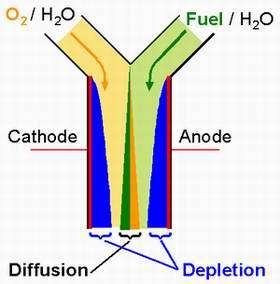
A fuel cell designed by researchers at the University of Illinois at Urbana-Champaign can operate without a solid membrane separating fuel and oxidant, and functions with alkaline chemistry in addition to the more common acidic chemistry.
Like a battery, a fuel cell changes chemical energy into electrical energy. While most fuel cells employ a physical barrier to separate the fuel and oxidant, the microfluidic fuel cell developed at Illinois utilizes multi-stream laminar flow to accomplish the same task.
Image: The system designed by Paul Kenis, a professor of chemical and biomolecular engineering, uses a Y-shaped microfluidic channel in which two liquid streams containing fule and oxidant merge and flow between catalyst-covered electrods without mixing. E.R. Choban, L.J. Markoski, A. Wieckowski, and P.J.A. Kenis:
Microfluidic Fuel Cell based on Laminar Flow Journal of Power Sources, 2004
“The system uses a Y-shaped microfluidic channel in which two liquid streams containing fuel and oxidant merge and flow between catalyst-covered electrodes without mixing,” said Paul Kenis, a professor of chemical and biomolecular engineering and a researcher at the Beckman Institute for Advanced Science and Technology.
Fluids flowing through channels of microscale dimensions behave differently than fluids flowing through the much larger pipes found in home plumbing systems, Kenis said. “At the microscale, there is no turbulence. This laminar flow means streams of fuel and oxidant can pass side by side without having a physical barrier in between.”
A fuel cell consists of two electrodes (an anode and a cathode), a fuel source and an oxidant. Reactions at the anode liberate protons and electrons from hydrogen atoms. The protons pass through the cell to the cathode, where they recombine with electrons, which traveled through an external circuit. Most fuel cells use a polymer electrolyte membrane to separate the cathode and anode.
In the Illinois fuel cell, the physical membrane is replaced by the behavior of laminar flow. The fuel and oxidant are brought together as liquid streams in the microchannel. The protons and electrons diffuse through the liquid-liquid interface.
This configuration offers several advantages over PEM-based fuel cells, including fewer parts and simpler design. It also means that membraneless fuel cells are compatible with alkaline chemistry.
Just as alkaline batteries outperform acidic batteries, alkaline fuel cells should be superior to acidic fuel cells, Kenis said. Several problems, however, have prevented the widespread use of alkaline chemistries in PEM-based fuel cells. Among them are poor permeability of the membranes to hydroxide ions (which take the place of protons in acidic fuel cells) and clogging of the membranes from the formation of carbonates.
“Our fuel cell doesn’t suffer from these problems, because it doesn’t make use of a membrane,” said Kenis, who will describe the novel fuel cell at the spring meeting of the American Physical Society, to be held in Los Angeles, March 21-25.
In applications such as power sources for portable computers or battery chargers, multiple fuel cells will have to be integrated to attain sufficient power levels.
“Since the membraneless fuel cell is based on a phenomenon that occurs only at the microscale, we can’t just scale up to larger dimensions,” Kenis said. “Instead, we need to scale out by creating arrays of many fuel cells connected in series and in parallel.”
Collaborators included chemistry professor Andrzej Wieckowski, postdoctoral research associates Lajos Gancs, Jayashree Ranga and Piotr Waszczuk (now at Guidant), graduate students Eric Choban (now at 3M) and Jacob Spendelow, and undergraduate Ajay Virkar.
The work was funded by the Army Research Office, the Beckman Institute, and the University of Illinois. The researchers have applied for a patent.
Source: University of Illinois at Urbana-Champaign (by James E. Kloeppel)


