Massive star cluster in our backyard - astronomically speaking!
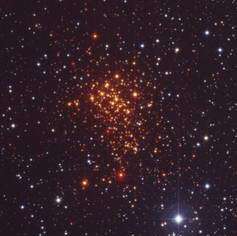
A team of European astronomers, including several from the UK, have uncovered a super star cluster in our own Galaxy, the Milky Way. This particular cluster, known as Westerlund 1, is a unique natural laboratory for the study of extreme stellar physics, helping astronomers to find out how the most massive stars in our Galaxy live and die.
Super star clusters are groups of hundreds of thousands of very young stars packed into an unbelievably small volume. Until now, super star clusters were known to exist very far away, mostly in pairs or groups of interacting galaxies.
Image: A composite image of the super star cluster "Westerlund 1" from 2.2-m MPG/ESO Wide-Field Imager (WFI) observations. The image covers a 5 x 5 arcmin sky region and is based on observations made in the V-band (550 nm, 2 min exposure time, associated to the blue channel), R-band (650nm, 1 min, green channel) and I-band (784nm, 18 sec, red channel). Only the central CCD of WFI was used, as the entire cluster fits comfortably inside it. The foreground stars appear blue, while the hot massive members of the cluster look orange, and the cool massive ones come out red.
Westerland 1 was discovered in 1961 but because it is hidden behind a large cloud of dust and gas its true nature had not been revealed until now. Using the European Southern Observatory's telescopes at the La Silla Observatory in Chile the team were able to penetrate beyond the dust and gas to the extent that they could distinguish individual stars within the super star cluster. Westerlund 1 is a thousand times closer than any other super star cluster known so far. It is close enough that astronomers may now probe its structure in some detail.
Westerlund 1 contains hundreds of very massive stars, some shining with a brilliance of almost one million suns and some two thousand times larger than the Sun (as large as the orbit of Saturn). Indeed if the Sun were located at the heart of this remarkable cluster, our sky would be full of hundreds of stars as bright as the full Moon.
From their observations, astronomers conclude that this extreme cluster most probably contains no less than 100,000 times the mass of the Sun, and all of its stars are contained in a region less than 6 light years across. Westerlund 1 appears to be the most massive compact young cluster yet identified in the Milky Way.
All the stars so far analysed in Westerlund 1 weigh at least 30-40 times more than the Sun. because stars have such a rather short life span - astronomically speaking Westerlund 1 must be very young. Astronomers determine an age lying between 3.5 and 5 million years. So Westerlund is a "newborn" cluster within our galaxy.
The large number of very massive stars implies that Westerlund 1 must contain a huge number of stars. Simon Clark, from University College London, one of the astronomers involved in this study explains, "In our Galaxy there are more than 100 solar like stars for every star weighing 10 times as much as the Sun. The fact that we see hundreds of massive stars in Westerlund 1 means that it probably contains close to a half a million stars, but most of them are not bright enough to peer through the obscuring cloud of dust and gas." This is 10 times more any other known Milky Way cluster.
A further surprise awaiting Clark and his colleagues was that these stars are packed into an amazingly small volume of space, less than 6 light years across.
"With so many stars in such a small volume, some of them collide", says Clark. This could lead to the formation of an intermediate black hole more massive than 100 solar masses. It may well be that such a monster has already formed at the core of Westerlund 1."
The cluster contains so many massive stars that in a time span of less than 40 million years, it will be the site of more than 1,500 supernovae - resulting in a giant firework display!
Further studies using high resolution cameras on the European Southern Observatory's Very Large Telescope will reveal more about this super star cluster. Westerlund 1 will certainly provide new opportunities in the long standing quest for more and finer detail about how stars, especially massive ones, do form.
Source: PPARC


