Probing Question: What is dark energy and how do we know it's there?
"Dark energy," said Donald Schneider, professor of astronomy at Penn State, "appears to be the major component of the universe." It's not the same thing as dark matter: ordinary planets, rocks, dust, and particles that do not emit light and therefore cannot be easily detected. It's something fundamentally different, outside our current understanding of physics -- a substance totally new to science.
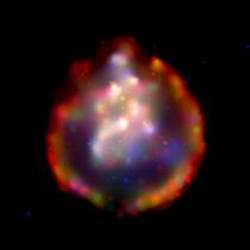
Image: This Chandra X-ray Observatory image illustrates a supernova's intense luminosity. Photo courtesy of Sangwook Park, Penn State University
Though dark energy itself can't be seen, Schneider, Vanden Berk and their colleagues believe there is far more of it in the universe than any other type of energy. It earned its "dark" moniker not from any occult effects, but because it has escaped direct detection by every instrument that physicists and astronomers have trained on it. "It is really the scientists who are in the dark," acknowledged Daniel Vanden Berk, Penn State research associate in astronomy.
The existence of dark energy was first suggested by experiment in the late 1990s, when a group of astronomers led by U.C. Berkeley's Saul Perlmutter observed unusual effects in a type of exploding star called Type Ia supernovae, which Schneider described as the "standard 60-watt light bulb of the distant universe." Every time these objects have been found in the cosmos, they have exhibited nearly the same luminosity, he explained, and the method of estimating their distance is well established.
Thus, it should be fairly straightforward to predict how bright these supernovae should appear to observers on Earth, based on their distance from us. To the surprise of the astronomical community, however, Perlmutter's team found that the distant Type Ias were much dimmer than predicted by mathematical models. The best explanation, Schneider said, is the presence of a huge, previously unknown energy source, something so big it could bend space enough to dim a star's appearance. That much energy would cause the whole universe to expand, overcoming gravity to drive galaxies farther and farther apart at an accelerating rate.
Large-scale experiments have since strengthened this hypothesis. The first, known as the Wilkinson Microwave Anisotropy Probe, or WMAP, looked at the microwave radiation that was produced shortly after the Big Bang, which contains the history of the universe's evolution since that time. Using what Schneider called "very reliable methods," the WMAP team determined that the universe was indeed expanding, and was best explained by a model made up of about 4 percent atoms, 23 percent dark matter and 73 percent dark energy.
At the same time, Schneider, Van den Berk and many other researchers were studying data compiled from the most comprehensive map yet constructed of the universe, the Sloan Digital Sky Survey. In particular, this team focused on the distributions of two constituents of the universe: massive galaxies and gaseous particles lying between Earth and super-bright and far-away objects called quasars. A quasar acts like a spotlight shining on the particles, Schneider explained, showing how "dusty" the universe is between the quasar and our telescopes. The distributions of galaxies and gaseous materials, like the apparent brilliance of a supernova, depend on the shape of the universe, which in turn depends on the amount of dark energy.
The results of the Sloan analysis, Schneider reported, provided independent methods for detecting the influence of dark energy and its measurements are in almost perfect agreement with the Wilkinson probe. Together, the Wilkinson and Sloan projects were judged the "Breakthrough of the Year" for 2003 by the journal Science.
Thus, the current picture of how the universe evolved looks something like this: Just after the Big Bang, the universe began a rapid expansion, its outward movement continuously slowed by gravity. As time passed, and the universe became larger, the amount of dark energy, which is related to the amount of space in the universe, increased. At some point several billion years ago, the expansion pressure exerted by dark energy equaled the compression produced by gravity. At this point, the rate of expansion began to accelerate instead of slowing down.
This model of the universe, while accounting for the recent surprising results, is still not fully understood. Though scientists accept that dark energy is the force driving the current evolution of the universe, no one has sufficiently explained why or how the amount of dark energy increases as the universe expands, or even what dark energy is. Some of the many competing theories incorporate the existence of extra dimensions.
The possibilities, Schneider admitted, are a little overwhelming, even for an astrophysicist.
"When I was your age, the universe was a lot simpler."
Source: Penn State (By Joseph Gyekis)


