Cell Phone with Built-in Projector
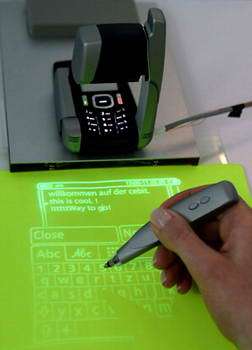
Siemens researchers have developed a cell phone featuring a built-in projector system. A laboratory model was presented at CeBIT 2005 in Hanover. The system makes it possible to project a complete keypad or display onto a surface. With a special pen, users can write on the virtual keypad and operate the phone’s functions.
At first glance, the mobile phone looks exactly like a conventional cell phone. On the side of the housing there is a swivel bracket that holds the projector unit. The light source is a tiny semiconductor laser that emits monochrome light to project a real-time image of the display. Depending on the position of the bracket, the image can be projected onto a surface in front of the phone or onto a wall. The projector system can even be used to give presentations and slide shows for small groups.
The pen for writing and telephoning is kept in the side of the bracket and features a built-in microphone and speaker. The signals are transmitted via Bluetooth. A distance sensor recognizes when a user is holding the pen to his or her ear and automatically reduces the volume. To write with the virtual keypad, the user simply “types” with the pen on the projected image. Sophisticated sensor technology recognizes the pen’s position in real time.
To obtain this measurement, the researchers from Siemens Communications use a combination of ultrasound and infrared. The pen point continuously sends infrared flashes to a sensor in the phone's housing, and these flashes form the basis for the starting point of the measurements. The pen point simultaneously emits ultrasound signals that are registered at two locations in the housing. A software then determines the exact position of the pen based on the time difference between the two signals.
The demonstration model isn’t a fully functional cell phone yet. At CeBIT, a laptop was used to handle the telephone functions. It hasn’t yet been decided whether Siemens will further develop this technology and launch a mobile phone equipped with this system on the market.


