Researchers bridge superconductivity gap
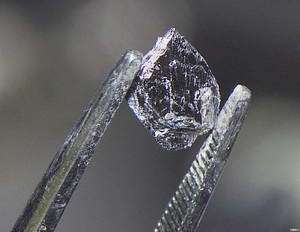
University of California scientists at Los Alamos National Laboratory working with a researcher from Chonnam National University in South Korea have found that magnetic fluctuations appear to be responsible for superconductivity in a compound called plutonium-cobalt-pentagallium (PuCoGa5). The discovery of this "unconventional superconductivity" may lead scientists to a whole new class of superconducting materials and toward the goal of eventually synthesizing "room-temperature" superconductors.
Photo credit: Los Alamos National Laboratory
In research reported in today's edition of the scientific journal Nature, Nicholas Curro and a team of researchers provide evidence of how magnetic fluctuations, rather than interactions mediated by tiny vibrations in the underlying crystal structure, may be responsible for the electron pairing that produces superconductivity in the mixture of plutonium, cobalt and gallium.
Superconductivity is an unusual state of matter in which electrical current flows without resistance through a material as a result of the material's electrons acting in pairs. Since the discovery at Los Alamos of PuCoGa5 roughly two years ago, a burning question has been whether the compound was just another garden-variety superconductor, a so-called s-wave superconductor, or an unconventional one that is mediated by magnetic fluctuations, a d-wave superconductor.
Although the temperatures at which superconductivity is observed are usually quite low, a handful of compounds like PuCoGa5 have been found to possess superconductivity at temperatures warmer than minus 427 degrees Fahrenheit. Even though that temperature seems low, PuCoGa5 possesses highest superconducting transition temperature among actinide based compounds found so far. This "unconventional superconductivity" suggests that PuCoGa5 may be one of a very small handful of superconductors whose superconductivity actually derives from magnetic correlations.
Scientists theorize that having found one unconventional superconductor like PuCoGa5, they may find more in the future. Making the research even more intriguing is the fact that plutonium is a base actinide material of the compound. This new class of magnetically mediated superconductors might encompass a broad range of materials, metals to oxides, and be the path toward superconductor science's ultimate goal to someday synthesize a "room-temperature" superconductor that would be the basis for the dissipation-less flow of electric current through power lines, and for an even more minute generation of computer chips. The discovery is the result of collaboration between the Laboratory's Materials Science and Technology and Theoretical divisions. In addition to Curro, the team includes Tod Caldwell, Eric Bauer, Luis Morales, Yunkyu Bang, Matthias Graf, Alexander Balatsky, Joe Thompson and John Sarrao.
Source: DOE/Los Alamos National Laboratory


