Picking on Einstein
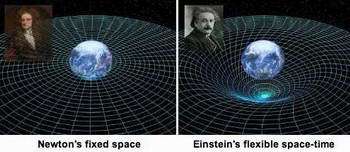
This year marks the 100th anniversary of a revolution in our notions of space and time.
Before 1905, when Albert Einstein published his theory of special relativity, most people believed that space and time were as Sir Isaac Newton described them back in the 17th century: Space was the fixed, unchanging "stage" upon which the great cosmic drama unfolded, and time was the mysterious, universal "clock in the sky."
Even today, people commonly assume that this intuitive sense of space and time is correct. It's not.
Image: Newton's fixed space vs. Einstein's flexible spacetime, from the film "Testing Einstein's Universe" by Norbert Bartel.
Einstein's 1905 paper, along with another one he published in 1915, painted an entirely different and mind-bending picture. Space itself is constantly being warped and curved by the matter and energy moving within it, and time flows at different rates for different observers. Numerous real-world experiments over the last 100 years indicate that, amazingly, Einstein was right.
But scientists today have reason to think that even Einstein's theory isn't the whole story; another revolution seems inevitable.
The reason for doubt is that Einstein's theory is incompatible with quantum mechanics, another pillar of modern physics that describes the odd world of subatomic particles. When the theories are used together, sometimes, their combined equations produce nonsense. This leads scientists to believe that current theories will eventually be replaced by a single, elegant theory that explains all physical phenomena from the subatomic to the cosmic, the so-called "Theory of Everything."
When will the first shots of this physics revolution ring out? Perhaps when Einstein, like Newton before him, is proven wrong--or at least not quite right.
To hunt for flaws in Einstein's theories, scientists are crafting experiments that can measure the predictions of relativity with ever-greater precision. One such experiment is NASA's Gravity Probe B (GP-B).
According to Einstein, Earth makes a dimple in the spacetime around it--something like a bowling ball sitting on a sheet of Spandex. Because Earth spins, this "dimple" is twisted into a shallow vortex. Gravity Probe B is orbiting Earth, right now, in search of these distortions.
GP-B senses the distortion of spacetime around our planet using gyroscopes. (There are four of them onboard the spacecraft.) Francis Everitt, principal investigator for GP-B and a professor at Stanford University, explains:
"Gyroscopes moving through curved spacetime will gradually change their direction of spin (i.e. tilt) with respect to the stars. GP-B will measure that tilting motion with extraordinary precision and from that measurement we can calculate the structure of space near the Earth."
Everitt will give a presentation about Gravity Probe B in April at the "Physics for the Third Millennium: II" conference hosted by NASA's Marshall Space Flight Center in Huntsville, Alabama. The conference is part of the World Year of Physics 2005, a United Nations-endorsed series of events to recognize the 100th anniversary of Einstein's seminal work and to raise public awareness of big issues in modern physics.
In addition to giving a status update on GP-B (in short: so far, so good), Everitt plans to explain how GP-B will measure gamma, an important physics variable used by scientists in their quest to go beyond Einstein's relativity. Roughly speaking, gamma corresponds to the curvature of three-dimensional space.
If Einstein's theory matched reality perfectly, gamma ought to be exactly equal to one. Measuring a value for gamma that's even slightly different from one would be the "first shot" that physicists have been waiting for.
"Gamma is the most sensitive way of measuring any possible deviation from Einstein, because it is sensitive to [any kind of unknown field]," says Thibault Damour, a professor at the Institut des Hautes Etudes Scientifiques, France, and an expert in theories that could replace relativity.
In the GP-B experiment, gamma contributes to the slight tilt of the gyroscopes' spin axes, which are expected to drift about 6.6 arcseconds (0.00183 degrees) during the year-long data-gathering phase of the mission. This drift should allow scientists to measure gamma within about 0.01% of its true value -- and perhaps as good as 0.001%, Everitt says.
If gamma turns out to be slightly less than one, it would support the idea that a new force field exists, akin to gravity but much weaker. Physicists call it a "scalar field." This new field is a feature of some candidate Theories of Everything, including string theory. String theory is popular because of its elegance in explaining all known physical phenomena, from the subatomic to the cosmic. The problem is that string theory is very hard to test in the real world, and no experimental evidence of the unique predictions of string theory has yet been found.
"Finding that gamma is slightly less than one would support the idea of a scalar field, and thus could provide some of the first experimental support for string theory," Thibault says.
If gamma turns out to be slightly greater than one, however, it would be "back to the drawing board" for theorists. No existing theories predict that gamma should be larger than one, so physicists would have no idea how to explain such a finding. "Let's just say that every time I ask theorists what it would mean if gamma were larger than one, they change the subject," laughs Everitt, himself an experimentalist.
GP-B might also find that, within the experiment's limits of precision, gamma is equal to one--just as Einstein predicted. What would that mean? Perhaps the flaw, if it exists, is smaller than GP-B can sense. Or maybe the revolution's first shots will ring out elsewhere. No one knows.
Gravity Probe B is half-way through its one-year mission. One hundred years down, six months to go. Stay tuned for answers.
Gravity Probe B -- (Stanford University) the mission's home page
Source: Science@NASA (by Patrick L. Barry, Dr. Tony Phillips)


