Astronomers Discover Mysterious New Star Clusters
April 4, 2005
Astronomers Discover Mysterious New Star Clusters

A UK-led team of astronomers has discovered a completely new type of star cluster around a neighbouring galaxy.
The new-found clusters contain hundreds of thousands of stars, a similar number to the so-called “globular” star clusters which have long been familiar to astronomers.
What distinguishes them from the globular clusters is that they are much larger – several hundred light years across – and hundreds of times less dense. The distances between the stars are, therefore, much greater within the newly discovered "extended clusters".

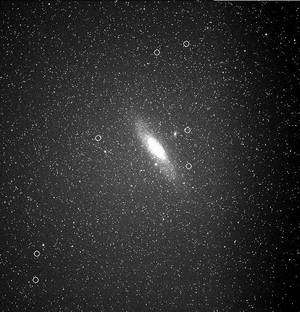
The above image shows the giant Andromeda spiral galaxy (M31), with circles indicating the locations of the newly discovered star clusters. The most distant cluster is about 200 thousand light years from the centre of M31. (Photo credit: WASP Consortium)

The discovery was made during the course of an unprecedentedly broad and detailed survey of the Milky Way’s nearby sister, the Andromeda Galaxy (often referred to by the catalogue number, M31). The survey has so far covered more than 50 square degrees of sky, compared with only a few degrees covered by all previous CCD surveys.

Part of this study involved a search for globular clusters around M31, during which the new “extended clusters” were found. The new clusters are distributed in a spherical ‘halo’ region extending about 200,000 light years from the giant M31 spiral galaxy.

“How these objects formed, and why there are no similar clusters in the Milky Way is still a mystery,” said Avon Huxor, a PhD student at the University of Hertfordshire who is presenting a poster describing the new results at the RAS National Astronomy Meeting in Birmingham this week.
“What is clear is that these clusters, like the globulars, are ancient. They are billions of years old - possibly amongst the first objects to form in the Universe.”

“It may be they were originally created not in M31, but as part of other small, so-called dwarf galaxies, which have subsequently between pulled apart and merged with the giant M31 galaxy,” commented team member Mike Irwin (University of Cambridge).

“That would be particularly exciting since they might then be more properly considered as the very smallest galaxies rather than star clusters, and help explain the apparent scarcity of such objects compared to theoretical predictions,” added Nial Tanvir, another University of Hertfordshire astronomer, who led this part of the work.

The data for the survey were acquired with the 2.5 m Isaac Newton Telescope in La Palma, Canary Islands, and the 3.6 m Canada-France-Hawaii Telescope in Hawaii. The observations were made using sensitive electronic CCD cameras; previous surveys of these regions had used photographic technology, which had failed to detect the faint clusters.

The team also included astronomers from France, Canada and Australia. A first paper announcing the discovery has been submitted to the Monthly Notices of the Royal Astronomical Society. Observations of the clusters with the Hubble Space Telescope are scheduled for later this year.

Source: Royal Astronomical Society (RAS)


Rank 3 /5 (5 votes)
Tags

Relevant PhysicsForums posts

More news stories

Mars Science Laboratory computer issue resolved

(PhysOrg.com) -- Engineers have found the root cause of a computer reset that occurred two months ago on NASA's Mars Science Laboratory and have determined how to correct it.

Space & Earth / Space Exploration

created 13 minutes ago | popularity not rated yet | comments 0 | with audio podcast

Putin receives 'prehistoric' water from Antarctic lake

Prime Minister Vladimir Putin was given a water sample Friday taken from a pristine lake hidden under Antarctic ice for over a million years, after Russian scientists drilled down to its surface.

Space & Earth / Earth Sciences

created 19 minutes ago | popularity 5 / 5 (1) | comments 0

Rockot to launch two Sentinel satellites

ESA and Eurockot today signed contracts for launching two ESA satellites: Sentinel-2A and Sentinel-3A will fly in 2013 on Rockot vehicles from the Plesetsk Cosmodrome in northern Russia for Europe’s GMES ...

Space & Earth / Space Exploration

created 15 minutes ago | popularity 5 / 5 (1) | comments 0

Probing a link from Sahara dust to climate change

Qilong Min, Ph.D., Senior Research Associate and Professor with the Atmospheric Sciences Research Center (ASRC) at the University at Albany is developing innovative ways to measure how dust in the Sahara Desert ...

Space & Earth / Earth Sciences

created 8 minutes ago | popularity not rated yet | comments 0

Humans may have helped the decline of African rainforests 3000 years ago

(PhysOrg.com) -- Large areas of rainforests in Central Africa mysteriously disappeared over three thousand years ago, to be replaced by savannas. The prevailing theory has been that the cause was a change ...

Space & Earth / Environment

created 3 hours ago | popularity 5 / 5 (2) | comments 0 | with audio podcast report


New error-correcting codes guarantee the fastest possible rate of data transmission

Error-correcting codes are one of the triumphs of the digital age. They’re a way of encoding information so that it can be transmitted across a communication channel — such as an optical fiber o ...

A frank discussion of the power law and linking correlation to causation

(PhysOrg.com) -- Michael Stumpf a mathematics professor at Imperial College in London, and Mason Porter a lecturer at Oxford have teamed together to write and publish a perspective piece in Science regarding the in ...

Advanced power-grid model finds low-cost, low-carbon future in West

(PhysOrg.com) -- The least expensive way for the Western U.S. to reduce greenhouse gas emissions enough to help prevent the worst consequences of global warming is to replace coal with renewable and other ...

Small modular reactor design could be a 'SUPERSTAR'

(PhysOrg.com) -- Though most of today's nuclear reactors are cooled by water, we've long known that there are alternatives; in fact, the world's first nuclear-powered electricity in 1951 came from a reactor ...

High school students test best with 7 hours' rest

(Medical Xpress) -- Whether or not you know any high school students that actually get nine hours of sleep each night, that’s what federal guidelines currently prescribe.

The question of life in the ancient world

There’s a general feeling that we don’t get the Greeks – ancient or modern. Many, including heads of state like Angela Merkel, visibly shake their head in exasperation, rightly or wrongly, at ...