Hitachi Demos 230 Gb Per Square Inch Data Density on Perpendicular Recording
1 Terabyte Hard Drives Possible
Hitachi Global Storage Technologies is today announcing new advancements to a 100-year-old magnetic recording technology that will set the stage for ultra-high capacities such as a 20-gigabyte(a) Microdrive or a one terabyte 3.5-inch hard drive.
To achieve this, Hitachi has demonstrated the industry's highest data density at 230 gigabits per square inch (Gb/in2) on perpendicular recording. Hitachi believes 230 Gb/in2, which represents a doubling of today's highest longitudinal recording densities, will be implemented in commercial hard drive products in 2007.
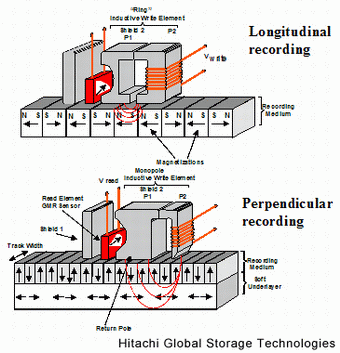
Longitudinal recording, as its name indicates, aligns the data bits horizontally, parallel to the surface of the disk. In contrast, perpendicular recording aligns the bits vertically, perpendicular to the disk, which allows additional room on a disk to pack more data, thus, enabling higher recording densities. One of the key challenges facing the hard drive industry is overcoming the constraints imposed by the superparamagnetic effect, which occurs when the microscopic magnetic grains on the disk become so tiny that they interfere with one another, thus losing their ability to hold their magnetic orientations. The result is “flipped bits” – bits whose magnetic north and south poles suddenly and spontaneously reverse – that corrupt data, rendering it and the storage device unreliable and thus unusable.
When fully realized over the next 5-7 years, perpendicular recording could enable a 10-fold increase in data densities over longitudinal recording, paving the way for new heights in capacity such as a 60 Gb one-inch drive.
Perpendicular recording has its roots in the late 19th century work of Danish scientist Valdemar Poulsen, who is generally considered the first person to magnetically record sound using perpendicular recording. The technology gets its name from the vertical alignment of data bits on the plane of the disk, which takes less room in contrast to the horizontal orientation of today's longitudinal recording technology. To be accurately recorded and read, the more closely-packed perpendicular bits also require a closer association between the read/write head and the recording media. Hitachi achieved the 230 Gb/in2 density by manipulating the head and media so that the distance between them is a mere 10 nanometers.
While the hard drive industry has been using longitudinal recording successfully for five decades, it is now within two product generations of reaching its practical limit. Researchers are finding that longitudinal recording is losing its ability to maintain data integrity at areal densities much beyond 120 Gb/in2.
"We are at the cusp of the most significant hard drive technology transition of the past decade, and it's one that holds so much promise for the hard drive and consumer electronics industries," said Jun Naruse, CEO, Hitachi Global Storage Technologies. "As the biggest supplier of small-form-factor hard drives, 2.5-inch and below, consumers' demand for storing more data on smaller devices has provided a strong impetus for us to pursue perpendicular recording with a greater sense of urgency."
While the transition to perpendicular recording will start as early as the next product generation, Hitachi believes the true potential will be realized in the 200+ Gb/in2 range -- the point of technology maturation when meaningful advancements in storage capacity will ensure full-scale adoption of perpendicular recording technology.
Perpendicular Recording Field Test
As the hard drive industry approaches the crossroad of this major transition in data recording technology, Hitachi is prepared to lead the charge with new achievements on perpendicular recording and a worldwide field test program. Testers have been using computing systems with perpendicular recording hard drives as part of their daily routine since December 2004. The program has revealed encouraging data about future mass-market adoption of the new technology, which Hitachi believes will gain momentum in 2006. Hitachi is taking the necessary steps to ensure a smooth transition to perpendicular recording through this extensive field test program and long-term reliability tests.
Professor Shun-ichi Iwasaki, president and chief director of Japan's Tohoku Institute of Technology, is considered to be the father of modern perpendicular recording and is among the early testers of Hitachi's perpendicular recording hard drives.
"I have been engaged in magnetic recording research since 1951 and found that the most important subject in this field is high-density recording," said Professor Iwasaki. "Around 1975, I began to feel that the vertical direction was the right way to go to attain high-density recording, and began leading the activities to make perpendicular recording a practical technology. I am very glad to see that the technology will come into use soon."
Participants in Hitachi's field test program are making history as one of the first people to write data vertically on a hard drive. These testers represent notable academia, industry luminaries and customers worldwide. Field testers are using notebook systems from various manufacturers with the Hitachi Travelstar 2.5-inch drive. The data gleaned from this program will help Hitachi prepare for the eventual full-scale production of perpendicular recording hard drives. Hitachi expects to ship its first perpendicular recording product in 2005 on a 2.5-inch hard drive, used in notebook computers and handheld consumer electronics.
"The health of this industry over the next 5-10 years is critically tied to the successful implementation and transition to perpendicular recording technology," said Jim Porter, hard drive industry analyst and historian, owner of DISK/TREND. "Hitachi is taking a responsible approach in assuring that it proceeds smoothly with extensive testing programs."
In addition to the field test program, Hitachi has implemented a long-term reliability and stress testing regimen, involving hundreds of perpendicular recording drives over many months.
Pushing Back the "Superparamagnetic Limit"
With longitudinal recording, the hard drive industry is quickly approaching a physical barrier called the "superparamagnetic limit," which occurs when the microscopic magnetic grains on the disk become so tiny that they are not strong enough to resist the various factors tending to demagnetize them. The result is that, over several years, the information written onto these magnetic grains can fade and become corrupted, rendering the storage device unreliable and unusable. Simplistically, the data bits can be thought of as little dominoes. Longitudinal recording, as its name indicates, lays these dominoes (data bits) horizontally, taking up more space. In contrast, perpendicular recording sets up the dominoes on their edges, allowing more bits per square inch of disk surface, resulting in higher storage capacity overall.


