Study finds Earth's auroras are not mirror images
Thanks to observations from the ground and satellites in space, scientists know that the North and South Poles light up at night with Auroras because a "solar wind" of electrified gas continually flows outward from the sun at high speed in all directions, including toward the Earth. Recently, however, NASA and university scientists looking at the Earth's northern and southern auroras were surprised to find they aren't mirror images of each other, as was once thought.
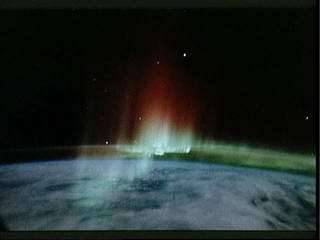
Image: Aurora Australis: This view of the Aurora Australis, or Southern Lights, which was photographed by an astronaut aboard Space Shuttle Discovery (STS-39) in 1991, shows a spiked band of red and green aurora above the Earth's Limb. Calculated to be at altitudes ranging from 80 - 120 km (approx. 50-80 miles), the auroral light shown is due to the "excitation" of atomic oxygen in the upper atmosphere by charged particles (electrons) streaming down from the magnetosphere above. Credit: NASA
According to scientists, the main cause behind the differences in location appears to be what occurs between the solar wind and Earth's magnetic field.
The Earth's magnetic field, like that of the sun and some of the other planets, is generated by electrical currents flowing inside them. The sun's magnetic field, like that of Earth, has a north and south pole linked by lines of magnetic force.
Looking at the auroras from space, they look like almost circular bands of light around the North and South Poles. At the North Pole, it's called aurora borealis, or northern lights, and at the South Pole it's called the aurora australis, or southern lights.
From spacecraft observations made in October, 2002, scientists noticed that these circular bands of aurora shift in opposite directions to each other depending on the orientation of the sun's magnetic field, which travels toward the Earth with the solar wind flow. They also noted that the auroras shift in opposite directions to each other depending on how far the Earth's northern magnetic pole is leaning toward the sun.
What was most surprising was that both the northern and southern auroral ovals were leaning toward the dawn (morning) side of the Earth for this event. The scientists suspect the leaning may be related to "imperfections" of the Earth's magnetic field.
"This is the first analysis to use simultaneous observations of the whole aurora in both the northern and southern hemispheres to track their locations," said lead author Timothy J. Stubbs of the Laboratory for Extraterrestrial Physics at NASA's Goddard Space Flight Center (LEP/GSFC), Greenbelt, Md.
The Earth's magnetic field provides an obstacle in the flow of the solar wind, and it becomes compressed into what looks like an extended tear-drop shaped bubble known as the "magnetosphere." The magnetosphere protects the Earth by shielding it from the solar wind. However, under certain conditions charged particles from the solar wind are able to get through Earth's magnetic shield and get energized. When this happens, they crash into the Earth's upper atmosphere and create the light which we see as an "aurora."
Stubbs and his colleagues, Richard R. Vondrak, and John B. Sigwarth, both of LEP/GSFC, Nikolai Østgaard at the University of Bergen, Norway and Louis A. Frank at the University of Iowa, used data from NASA's Polar and IMAGE (Imager for Magnetopause-to-Aurora Global Exploration) spacecraft to study the auroras. It was by luck that the orbits of Polar and IMAGE were aligned such that the entire auroras at the north and south poles could be observed in detail at the same time.
By knowing how auroras react to the solar wind, scientists can better determine the impacts of space weather in the future. The new discovery shows that auroras may be more complicated than previously thought.
Source: NASA/Goddard Space Flight Center--EOS Project Science Office


