Timing nature’s fastest optical shutter
It's nature's fastest quick-change artist: In less than the time it takes a beam of light to travel a tenth of a millimeter, vanadium dioxide can switch from a transparent to a reflective, mirror-like state.
How this material (VO2) can turn from a transparent insulator into a reflective metal so rapidly has physicists scratching their heads, but a collaboration among researchers at Vanderbilt, Oak Ridge National Laboratory and Lawrence Berkeley National Laboratory has clocked the transfiguration at one-tenth of a trillionth of a second.
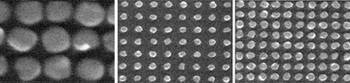
Image: Three examples of nanocrystal arrays (Courtesy of Richard Haglund)
“The change from insulator to metal is called a phase transition,” explains Richard Haglund, the Vanderbilt physics professor who directed the study published in the March issue of Optics Letters. “Phase transitions in solids generally occur at the speed of sound in the material, but vanadium dioxide makes the switch 10 times faster. So far no one has succeeded in coming up with a definitive explanation for that rapid a change.”
Vanadium dioxide’s quick-change act isn’t merely a matter of academic interest, although there’s plenty of that:
-- In 1982, a patent was filed on the idea of using a thin film of vanadium dioxide as the active ingredient in “thermochromic windows” as an energy saving device. When the material is colder than 68 degrees Celsius (154 degrees Fahrenheit) it is transparent. When it is heated a few degrees higher, however, it becomes reflective. So the basic idea is to create windows that are transparent at lower temperatures and then block out sunlight when the temperature soars, cutting down on air-conditioning bills.
-- A more futuristic potential application is to use vanadium dioxide nanoparticles as microscopic thermometers. It is relatively easy to change the material’s transition temperature to body temperature (98 degrees Fahrenheit; 37 degrees Celsius) by adding precise amounts of impurities. Such doped nanoparticles would be small enough to measure the temperature at different locations within an individual cell and, when injected into the body, could pinpoint hot spots by turning into microscopic mirrors.
-- Other applications that have been suggested for this unusual material include chemical sensors, transparent electrical conductors and various kinds of ultra-fast electrical and optical switches.
Although vanadium dioxide’s insulator/metal phase change has been known for some time, it is only recently that scientists have discovered how rapidly it can occur. In bulk quantities, the transition is dominated by the rate at which heat can spread through the material, which is a relatively slow process. It was only when researchers found ways to make it in extremely thin layers that they began to discover the unusual speed with which vanadium dioxide can make this transition. This discovery was made by co-author Andrea Cavalleri and his collaborators, first at UC San Diego and then in Robert Schoenlein’s group at Lawrence Berkeley National Laboratory.
Schoenlein’s group, working with thin films, and the Vanderbilt group, working with nanoparticles, reported these extremely fast switching speeds in the last year. But they weren’t certain whether the transition they were measuring went from the insulator phase to an intermediate state—a phenomenon common in other materials with fast transition times—or directly to the metallic state.
In the latest paper, the researchers answered that question by detecting the appearance of a phenomenon called “surface plasmon resonance.” This is a form of electron wave that only occurs on the surfaces of metals and is responsible for the glowing colors of stained glass. Detection of this effect confirmed that vanadium dioxide can switch all the way from transparent to reflective in less than 100 femtoseconds (a tenth of a trillionth of a second). Matteo Rini, a postdoctoral scholar in the Schoenlein group, carried out the ultrafast optical measurements on nanomaterials prepared and characterized by René Lopez, research assistant professor of physics at Vanderbilt.
“We know that the reverse process—going from metallic to insulator—is somewhat slower,” says Haglund, “But we don’t know how much slower because we haven’t been able to measure it.”
The Vanderbilt researchers got involved with the unusual material when they collaborated with scientists at Oak Ridge National Laboratory to produce nanoparticles of vanadium dioxide by a brute-force method called ion implantation. René Lopez, a doctoral student at the time, spent two years at ORNL FUNDED BY THE DEPARTMENT OF ENERGY figuring out how to use the lab’s large ion implantation accelerator to create VO2 nanoparticles.
Almost before the ink on Lopez’s thesis was dry, Haglund’s group, in collaboration with Stevenson Professor of Physics Leonard Feldman, chemistry professor Charles Lukehart and Charles Aziz in Harvard’s Division of Engineering and Applied Sciences, submitted a proposal to the National Science Foundation to study the way in which the properties of nanoparticles made of vanadium dioxide and other oxides vary with size. In the time between submitting the proposal and receiving a $1 million grant from NSF’s highly competitive Nanoscience Interdisciplinary Research Team program, however, Oak Ridge shut down its ion implantation facility a number of months earlier than previously planned.
“There we were, finally funded by this large grant,” Haglund recalls, “and we suddenly found that we had to move to a more sophisticated technique of nanoparticles synthesis much more rapidly than we had planned.”
Fortunately, Vanderbilt had recently set up a new Institute of Nanoscale Science and Technology (VINSE), which had acquired a number of new instruments that make it possible to create nanoscale structures. “As the vanadium dioxide research demonstrates, creating new forms of materials on the nanoscale is a major enabler of new and exciting discoveries,” says Feldman, who participated in the study and directs the nanoscience institute.
VINSE provided the researchers with an alternative means of making vanadium dioxide nanoparticles: a technology used to make integrated circuits called lithography. Basically this involves creating a pattern of depressions in a plate of silicon dioxide using a finely focused ion beam and then exposing this surface to a vanadium dioxide vapor which collects in the depressions to form nanoparticles. It took them a year of intense effort, but they finally came up with a new and better way of making the nanoparticles they needed to complete the project.
In the ion implantation process, the nanoparticles were randomly distributed in the silicon dioxide substrate. The lithography approach, by contrast, produces regular arrays of nanoparticles that the researchers can vary by size, by spacing, by shape and by pattern.
This has allowed them to verify that nanoparticles undergo the same phase transition as thin films. They also have determined that the effect has a size limit: It does not occur in particles that are smaller than about 20 atoms across (10 nanometers). The researchers have established that it is possible to raise and lower the temperature at which the insulator/metal transition takes place by as much as 35 degrees Celsius by adding small amounts of impurities.
The researchers have just begun exploring the novel properties that different arrays exhibit. For example, at one size and spacing, an array doesn’t just change from transparent to reflective and back, it switches from transparent to more transparent, then to less transparent, and finally to metallic. Such effects are part of the strange and often counter-intuitive world of nanoscience where materials can behave quite differently than they do at larger scales.
Such novel behaviors have the researchers thinking of a variety of possible applications. For example, they are exploring whether they can create an “ultrafast” optical switch by putting a layer of vanadium dioxide nanoparticles on the end of an optical fiber. Such a switch could be useful in communications and optical computing.
Beyond the possible practical applications, there is some “deep science” involved, Haglund maintains. It just so happens that vanadium dioxide is a member of a large class of “strongly correlated materials.” This includes high-temperature superconductors and ferroelectric materials that are used in cell phones and a variety of other electronic devices. In these materials, the freely flowing electrons and the atoms that form the crystal lattice are in an uneasy state of coexistence. As a result, the flow of electrons can trigger movements in the lattice. This differs from normal materials, like quartz, where the atoms in the crystal lattice are firmly held in place. Because this phenomenon plays an important role in the unusual electrical properties of these materials, scientists put a high priority on understanding this behavior.
Additional collaborators in the vanadium dioxide studies are Leonard C. Feldman, Stevenson Professor of Physics at Vanderbilt University, Lynn A. Boatner and Tony E. Haynes from Oak Ridge National Laboratory.
Source: Vanderbilt University


