Research team recreates ancient underwater concrete technology
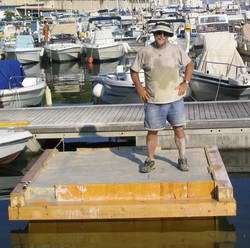
A University of Colorado at Boulder professor and his colleagues have taken a page from the writings of an ancient Roman architect and built an underwater concrete pier in the manner of those set in the Mediterranean Sea 2,000 years ago.
CU-Boulder history Professor Robert Hohlfelder, an internationally known underwater archaeologist, said scholars have long been in awe of the engineering feats of the early Romans. A former co-director of the international Caesarea Ancient Harbor Excavation Project, he said the research effort was spurred by the stunning hydraulic concrete efforts undertaken at Caesarea Harbor in present-day Israel and elsewhere in the Mediterranean before the time of Christ.
Hohlfelder, who teamed up on the project with London architect and archaeologist Christopher Brandon and Greek and Roman Studies Professor John Peter Oleson of Canada's University of Victoria, said the writings of ancient Roman Pollio Vitruvius provided a key starting point. Vitruvius published 10 books on architecture circa 25 B.C. describing the building and engineering methods practiced during the Roman Empire, including ancient harbor construction.
"The writings of Vitruvius are a window on the engineering efforts of ancient Romans," said Hohlfelder. "But we still had a number of questions about the use of ancient hydraulic concrete, and felt the only way to answer them was to attempt our own project based on what the ancients did and the materials they used."
The three researchers formed the Roman Maritime Concrete Structure Study, or ROMACONS, in 2002, and began collecting and testing hydraulic concrete cores from early Roman structures around the Mediterranean region. In addition to analyzing the composition and strength of different cores, they also were able to trace raw materials to specific Mediterranean sources with the help of CU-Boulder geology Professor Charles Stern, illuminating ancient trading patterns.
While Vitruvius explained how to build the wooden forms for underwater concrete structures, he did not specify how they were anchored to the seafloor, how the mortar was poured, how aggregate materials like stone chunks were added or how long it took the concrete to cure, Hohlfelder said.
In 2004, the team obtained a study site through the Italcemente Group, an Italian concrete company with a marine testing station in the harbor of Brindisi, Italy, to build a free-standing concrete pier, or "pila" -- a common feature in ancient Roman harbors. They designed the pila to be small -- about two meters on a side and two meters high -- reaching just above the water's surface at high tide, he said.
In September 2004 the team drove wooden planks into the submerged seafloor to make the forms, which were reinforced with horizontal beams to form a box. "We had seen impressions of these vertical wooden planks in Roman concrete, and wondered if the cracks between planks had to be caulked to prevent concrete leakage," he said. "But the thick mix they used may have made this unnecessary."
They used the Roman recipe for concrete passed down by Vitruvius. It included seawater, lime and sand (pozzolana) and chunks of volcanic rock from the Bay of Naples -- the same source for material used in ancient construction efforts at Caesarea and elsewhere in the region. The lime powder combined with sand and water made up the mortar, which would bind the aggregate into a solid mass of concrete.
Individual loads of the mortar were plopped into the form by the team using a wicker basket rigged with a "trip-line" modeled after ancient Roman illustrations of construction scenes with similar baskets and from actual artifacts recovered by archaeologists from an ancient shipwreck site near Pisa, he said. The team used hand tools to tamp the aggregate into the mortar as the structure slowly rose from the seafloor.
The three men finished the pila in September 2004 after using 13 tons of raw material and expending 273 work-hours, capping the top with paving stones in the manner of the early Romans. "We believe this is the first structure built with these materials and techniques in at least 1,600 years," said Hohlfelder.
The team will extract cores from the pila and analyze them later this year to assess the underwater curing rate of the concrete, he said.
"We think we have a better idea now about what went on day-to-day when Caesarea Harbor and other ports in the Mediterranean were being constructed," he said.
Hohlfelder has studied ancient shipwreck remains off Cyprus, Greece and Israel and 10 ancient harbors -- including the submerged town of Aperlae in present-day Turkey -- during his academic career at CU-Boulder.
The 100-acre Caesarea Harbor, the world's first port constructed in the open sea, is considered one of the most innovative and successful engineering feats of the ancient world. Framed by two artificial breakwaters and containing a lighthouse, towers and warehouses that served ships throughout the Mediterranean for more than 1,200 years, the harbor was completed about 15 B.C.
Source: University of Colorado at Boulder


