NASA to Begin Test of 20-Meter Solar Sail
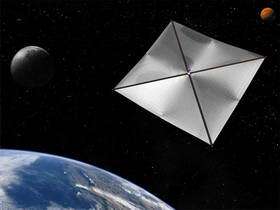
Technology That Could Use Sun's Energy for Future Space Missions
NASA engineers and their industry partners are preparing to test two 20-meter (66-feet) long solar sail propulsion system designs -- a critical milestone in development of a unique propulsion technology using the Sun's energy that could lead to future deep space missions.
The systems tests, scheduled for April through July, will be conducted at the NASA Glenn Research Center's Plum Brook Station in Sandusky, Ohio.
Drawing energy from the Sun, much the way the wind pushes sailboats across water, solar sail propulsion provides the "fuel" for a spacecraft to travel through space. The technology bounces a stream of solar energy particles, called photons, off giant, reflective sails made of lightweight material 40-to-100 times thinner than a piece of writing paper. The continuous sunlight pressure provides sufficient thrust to perform maneuvers, such as hovering at a fixed point in space and rotating the vehicle's plane of orbit. Such a maneuver would require a significant amount of propellant for conventional rocket systems. Because the Sun provides the necessary propulsive energy, solar sails require no onboard propellant, thus increasing the range of mobility or the capability to hover at a fixed point in space for longer periods of time.
"A spacecraft utilizing solar sail propulsion can deploy a large, lightweight reflector -- up to tens of meters long, but very, very lightweight -- that can reflect sunlight," says Les Johnson, manager of the In-Space Office at the Marshall Center. "As it reflects the Sun's energy, the sail will move and carry a small payload or a spacecraft along with it."
"As long as there's sunlight, there can be propulsion," adds Johnson.
The 20-meter solar sail system designs were developed by two engineering firms, L'Garde Inc., of Tustin, Calif.; and ATK Space Systems of Goleta, Calif. Their work is led by the In-Space Propulsion Technology Office at NASA's Marshall Space Flight Center in Huntsville, Ala.
Engineers at L'Garde and ATK Space Systems-Goleta have spent several months putting finishing touches on their system designs in preparation for the test series. L'Garde's sail technology uses an inflatable boom system that becomes stiff in space environment conditions. The system is approximately 14 meters (46 feet) long and supports the sail material and includes a stowage structure and built-in deployment mechanism.
ATK Space Systems-Goleta's solar sail technology system employs a "coilable" graphite boom. The boom was designed, manufactured and tested at the company's California facility. It is extended, or uncoiled, via remote control -- much the way a screw is rotated to remove it from an object -- and supports the lightweight sail, made of an aluminized, temperature-resistant material called CP-1. The material is produced under license by SRS Technologies of Huntsville. The sail and boom systems are then assembled into one system and tested at the West Coast facility.
The 20-meter test series will be conducted in a vacuum chamber -- to simulate the space environment. ATK Space Systems-Goleta will begin its tests in April 2005, while L'Garde's testing begins in June. Each test series is expected to last up to 30 days.
Solar sail technology was selected for development in August 2002 by NASA's Science Mission Directorate in Washington. Along with sail system design projects by L'Garde and ATK Space Systems-Goleta, NASA's Jet Propulsion Laboratory in Pasadena, Calif., was tapped to develop an integrated set of computer-based solar sail simulation tools. These are just three of a number of efforts undertaken by NASA Centers, industry and academia to develop solar sail technology.
Solar sail technology is being developed by the In-Space Propulsion Technology Program, managed by NASA's Science Mission Directorate and implemented by the In-Space Propulsion Technology Office at Marshall. The program's objective is to develop in-space propulsion technologies that can enable or benefit near or mid-term NASA space science missions by significantly reducing cost, mass and travel times.
Source: NASA


