Faster handoff between Wi-Fi networks promises near-seamless 802.11 roaming
Road warriors may no longer have to stay put in an airport lounge or Starbucks to access the high-speed Internet via an 802.11 Wi-Fi network. Thanks to software developed by two computer scientists at the University of California, San Diego, the time it takes to hand off from one Wi-Fi wireless network to the next can be dramatically shortened -- overcoming a major obstacle in Wi-Fi roaming.
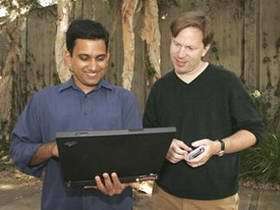
Photo: Computer science professor Stefan Savage (right) and grad student Ishwar Ramani test their Wi-Fi handoff algorithm
Jacobs School of Engineering professor Stefan Savage and graduate student Ishwar Ramani have a patent pending on the basic invention behind SyncScan, a process to achieve practical, fast handoff for 802.11 infrastructure networks. Their study will be published in the Proceedings of the IEEE InfoCom 2005.
"Wi-Fi offers tremendous speeds if you stay in one place or at least within 100 meters of the same access point," said Savage, an assistant professor in the Computer Science and Engineering department and academic participant in the California Institute for Telecommunications and Information Technology. "SyncScan is a handoff algorithm which can cut the time it takes to switch from one Wi-Fi access point to another by a factor of a hundred over existing solutions. This is a requirement for demanding applications like Voice over Wi-Fi [VoWi-Fi], where even short interruptions can disrupt the illusion of continuous connectivity." Savage notes that SyncScan also allows mobile devices to make better handoff decisions and therefore improve signal quality overall.
At present, Wi-Fi handoffs are cumbersome and time-consuming. Not until the access-point signal weakens substantially and begins losing packets of data does a Wi-Fi-enabled laptop, PDA or mobile phone begin scanning for a stronger signal. At that point, it broadcasts requests on all channels to find nearby access points. The result: a delay of up to one second, during which any packets may be lost. That may not seem inordinate when downloading data, but it can be unacceptable if the user is trying to listen to Internet radio, watch a streaming movie trailer or talk on a Wi-Fi phone.
"Today most Wi-Fi users accept being tethered to a single location in exchange for the broadband speeds that Wi-Fi offers," said Ph.D. candidate Ramani. "But increasingly they want to be able to make Voice of IP (VoIP)phone calls or stream multimedia while commuting or on the move, and a one-second disruption can seem like an eternity."
The SyncScan solution proposed by Savage and Ramani is a method to continuously monitor the proximity of nearby 802.11 access points. Instead of looking for surrounding access points just when the current signal is running low, a Wi-Fi device with SyncScan regularly checks signal strengths nearby - but only for very short periods of time. These times are picked to precisely coincide with regularly scheduled "beacon" messages sent by all standard Wi-Fi access points. The process eliminates the current need to start from scratch when looking for a stronger signal, and replaces the long scanning delay with many small delays that are imperceptible to the user.
To test their SyncScan algorithm, the researchers used a laptop running a voice application while walking between two areas of the UCSD campus served by neighboring Wi-Fi access points. "We used a popular VoIP called Skype which uses UDP [user datagram protocol] packets exchanged between two clients for voice communication," explained Savage. "Using SyncScan with a measurement interval of 500 millseconds, handoff delay was virtually imperceptible - roughly 5 milliseconds. Repeating the tests without SyncScan, the average handoff time was 450 milliseconds, but ranging up to a full second in some cases."
The researchers also observed a big difference in the number of lost data packets that can contribute to loss of data or voice dropout. Zero packets were dropped using the SyncScan algorithm in the UCSD tests, compared to substantial packet losses using current technology. "That is because the overhead of scanning for nearby base stations when the current signal weakens is routinely over 250 milliseconds, during which incoming packets are dropped," said Ramani. "We expect that the same improvements can be achieved on most Wi-Fi devices and using most applications, not just voice." SyncScan is also economical, because it can be deployed incrementally and implemented in software without requiring any changes to the 802.11 standard or any hardware upgrades.
Just over 110,000 VoWi-Fi handsets were sold in 2004, mostly in Japan. Vonage is set to roll it out commercially in the U.S. later this spring as an add-on to its popular VoIP service, and sales of dual-use phones incorporating both cellular and VoWi-Fi could reach $3 billion by 2009, according to a study by Infonetics Research.
Source: University of California - San Diego


