Physicist dates lifetime of solar nebula at two million years
April 20, 2005
Physicist dates lifetime of solar nebula at two million years

The oxygen and magnesium content of some of the oldest objects in the universe are giving clues to the lifetime of the solar nebula, the mass of dust and gas that eventually led to the formation of our solar system.
By looking at the content of chondrules and calcium aluminum-rich inclusions (CAIs), both components of the primitive meteorite Allende, Lab physicist Ian Hutcheon, with colleagues from the University of Hawaii at Manoa, the Tokyo Institute of Technology and the Smithsonian Institution, found that the age difference between the two fragments points directly to the lifetime of the solar nebula.

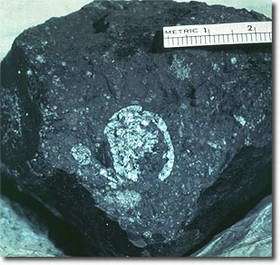
Image: Researchers analyzed the calcium aluminum-rich inclusion (CAI), the larger circular object in the center of the photo, and the chondrule, the smaller circular object on the left, in a hand specimen of the Allende meteorite.

CAIs were formed in an oxygen-rich environment and date to 4.567 billion years old, while chondrules were formed in an oxygen setting much like that on Earth and date to 4.565 billion, or less, years old.

“Over this span of about two million years, the oxygen in the solar nebula changed substantially in its isotopic makeup,” Hutcheon said. “This is telling us that oxygen was evolving fairly rapidly.”

The research appears in the April 21 edition of the journal Nature.

One of the signatures of CAIs is an enrichment of the isotope Oxygen 16 (O-16). An isotope is a variation of an element that is heavier or lighter than the standard form of the element because each atom has more or fewer neutrons in its nucleus. The CAIs in this study are enriched with an amount of O-16 4 percent more than that found on Earth. And, while 4 percent may not sound like much, this O-16 enrichment is an indelible signature of the oldest solar system objects, like CAIs. CAIs and chondrules are tens of millions of years older than more modern objects in the solar system, such as planets, which formed about 4.5 billion years ago.

“By the time chondrules formed, the O-16 content changed to resemble what we have on Earth today,” Hutcheon said.

In the past, the estimated lifetime of the solar nebula ranged from less than a million years to ten million years. However, through analysis of the mineral composition and oxygen and magnesium isotope content of CAIs and chondrules, the team was able to refine that lifespan to roughly two million years.

“In the past the age difference between CAIs and chondrules was not well-defined,” Hutcheon said. “Refining the lifetime of the solar nebula is quite significant in terms of understanding how our solar system formed.”

Source: Lawrence Livermore National Laboratory


Rank not rated yet
Tags

Relevant PhysicsForums posts

More news stories

Putting the squeeze on planets outside our solar system

(PhysOrg.com) -- Using high-powered lasers, scientists at Lawrence Livermore National Laboratory and collaborators discovered that molten magnesium silicate undergoes a phase change in the liquid state, abruptly ...

Physics / Condensed Matter

created 18 hours ago | popularity 4.3 / 5 (7) | comments 0 | with audio podcast

Hovering not hard if you're top-heavy, researchers find

Top-heavy structures are more likely to maintain their balance while hovering in the air than are those that bear a lower center of gravity, researchers at New York University's Courant Institute of Mathematical Sciences ...

Physics / General Physics

created 19 hours ago | popularity 5 / 5 (2) | comments 1 | with audio podcast

SLAC, Stanford team focuses on high-energy electrons to treat cancer

Accelerator physicists at SLAC and cancer specialists from Stanford are working on a new technology that could dramatically reduce the time needed for cancer radiation treatments. The team ran an initial experiment ...

Physics / General Physics

created 22 hours ago | popularity 5 / 5 (2) | comments 0

Measurements from high-energy collisions lead to better understanding of why meson particles disappear

For several years, physicists at the Relativistic Heavy Ion Collider (RHIC) at Brookhaven National Laboratory (BNL), USA, have studied an unusual state of matter called the quark–gluon plasma, which they ...

Physics / General Physics

created 23 hours ago | popularity 4.5 / 5 (4) | comments 0

Explained: Sigma

It's a question that arises with virtually every major new finding in science or medicine: What makes a result reliable enough to be taken seriously? The answer has to do with statistical significance -- but ...

Physics / General Physics

created Feb 09, 2012 | popularity 5 / 5 (17) | comments 53


Anonymous knocks CIA website offline (Update)

The website of the Central Intelligence Agency was inaccessible on Friday after the hacker group Anonymous claimed to have knocked it offline.

Small modular reactor design could be a 'SUPERSTAR'

(PhysOrg.com) -- Though most of today's nuclear reactors are cooled by water, we've long known that there are alternatives; in fact, the world's first nuclear-powered electricity in 1951 came from a reactor ...

New power source discovered

(PhysOrg.com) -- Researchers at the Massachusetts Institute of Technology (MIT) and RMIT University have made a breakthrough in energy storage and power generation.

Advanced power-grid model finds low-cost, low-carbon future in West

(PhysOrg.com) -- The least expensive way for the Western U.S. to reduce greenhouse gas emissions enough to help prevent the worst consequences of global warming is to replace coal with renewable and other ...

The power of estrogen -- male snakes attract other males

A new study has shown that boosting the estrogen levels of male garter snakes causes them to secrete the same pheromones that females use to attract suitors, and turned the males into just about the sexiest ...

Fool's gold may prove an unlikely alternative to overexploited catalytic materials

Catalytic materials, which lower the energy barriers for chemical reactions, are used in everything from the commercial production of chemicals to catalytic converters in car engines. However, with current catalytic materials ...