Living metals
Using Synchrotron x-ray microbeams, a research team from the Max Planck Institute for Metals Research in Stuttgart and the ESRF has been able to observe for the first time that the microscopic structure of a crystalline material fluctuates in time. The results are just shed in Science Express with the title: Scaling in the Time Domain: Universal Dynamics of Order Fluctuations in Fe3Al.
The research team investigated a metal alloy, composed of iron and aluminium. When the structure of such a crystalline material changes upon heating, x-ray scientists can observe this by means of a diffraction experiment: One class of interference peaks associated with the low-temperature structure disappears, while another class of x-ray peaks belonging to the new structure may emerge. For a fixed temperature, however, the x-ray diffraction pattern has hitherto always been found to be static according to standard textbook wisdom. The novel observation is now that this x-ray diffraction pattern shows fluctuations in time when the beam is focused to a very small size of a few micrometers. This gives clearcut evidence that temporal structural fluctuations on an atomic scale are present in the crystal. By using a very small beam, the number of the temporal fluctuations "seen" by the x-ray beam is so small that these fluctuations now become visible as x-ray intensity fluctuations.
This discovery helps to shed light on a very fundamental aspect in the theory of condensed matter, namely to understand and predict how a given material reacts upon external perturbations like changes in temperature, pressure, magnetic or electric fields. Solid state theorists predicted a long time ago that the way that a material responds to these changes of external conditions is governed by these temporal fluctuations in the system. For the iron-aluminium alloy that was studied, these experimental results can be used for a test of the existence of universal, materials-independent laws in the dynamics of microscopic fluctuations.
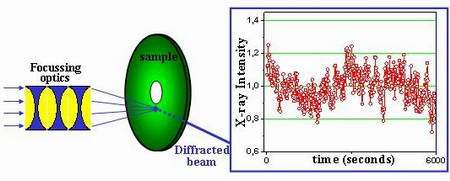
The figure shows the experiment schematically. A parallel beam is focused in a very thin area of the sample. Due to fluctuations in the material, the intensity of the diffracted x-ray beam fluctuates in time. The experiment was carried out on the ID22 beamline of the ESRF using a focused beam of 2x2 µm2 and probing a sample volume of 2x2x2 µm3. This challenging experiment became feasible thanks to the highly stable beam of the ESRF, the advances in sample preparation which allowed scientists to obtain very small sample volume and the accurately controlled experimental conditions (temperature, purity of the sample).
Source: European Synchrotron Radiation Facility


