USC scientist invents technique to grow superconducting and magnetic 'nanocables'
July 15, 2004 UCL - nanocable

A University of Southern California engineer has discovered a way to manufacture composite "nanocables" from a potent new class of substances with extraordinary properties called Transition Metal Oxides (TMOs).

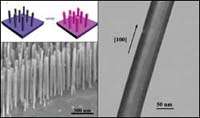
Chongwu Zhou, an assistant professor in the USC Viterbi School of Engineering’s Department of Electrical Engineering, is creating dense arrays of ultrafine wires made of magnesium oxide (MgO), each coated with uniform, precisely controlled layers of TMO.

In the last decade, TMOs have come under intense investigation because they demonstrate a wide range of potentially highly useful properties including high-temperature superconductivity. Because of the great potential for applications and research, investigators have tried for years to create TMO nanowires, but have so far had limited success. "But now we can supply a group of previously unavailable materials to the nanotechnology community," Zhou said.

The Zhou team demonstrated the technique with four different TMOs: YBCO, a well-known superconductor with a high transition temperature; LCMO, a material showing "colossal" magnetoresistance; PZT, an important ferroelectric material; and Fe3O4, known as magnetite in its strongly magnetic mineral form.

The new structures all start with a new technique Zhou and his co-workers developed to create arrays of nanowires by condensing MgO vapor onto MgO plates using gold as catalyst. This leads to a forest of MgO nanowires, each 30-100 nanometers in diameter and 3 microns (100 millionth of an inch) long, all growing parallel fashion, at a constant angle to the substrate plate.

"Now the magic starts," Zhou says. A laser vaporizes the TMO, which then condenses directly out of the gaseous state onto the waiting MgO cores in very precise fashion, a process called "pulsed laser deposition."

The final product looks like nano-sized coaxial cable, with an MgO core and TMO sheath. "The trick is we can preserve the TMO composition using this technique," says Zhou, "while other techniques cannot."

Zhou wrote in a paper recently accepted for publication in Nano Letters and now circulating on the Internet, that the assemblies "can be tailored for a wide variety of applications, including low-loss power delivery, quantum computing, ultrahigh density magnetic data storage, and more recently, spintronic applications."

"We … expect that these TMO nanowires may offer enormous opportunities to explore intriguing physics at the nanoscale dimensions."

Zhou, the winner of the Viterbi School of Engineering’s 2004 Junior Faculty Research Award, believes that the four new nanowires are only the beginning. "Our synthetic approach will lead to other new nanostructures," he said.

More information: http://www.usc.edu


print this article email this article download pdf blog this article bookmark this article     Stumble it Digg this share on Facebook retweet share on Reddit add to delicious
Rate this story - 2 /5 (1 vote)


July 15, 2004 all stories

Comments: 0

2 /5 (1 vote)
  • Stumble this up

  • Digg this

  • share this

  • hide
  • Related Stories

  • Metobolomics uncovers key indicators of nonalcoholic fatty liver disease
    created 5 hours ago | popularity not rated yet | comments 0
  • PLoS Genetics 2009 maize genome collection
    created Nov 19, 2009 | popularity not rated yet | comments 0
  • Is hepatic differentiation of embryonic stem cells induced by valproic acid and cytokines?
    created Nov 18, 2009 | popularity not rated yet | comments 0
  • Small nanoparticles bring big improvement to medical imaging
    created Nov 18, 2009 | popularity not rated yet | comments 0
  • Imaging a catalyst one atom at a time
    created Nov 09, 2009 | popularity not rated yet | comments 0


Other News

Peptides control crystal growth with 'switches, throttles and brakes'

Peptides control crystal growth with 'switches, throttles and brakes'

Nanotechnology / Bio & Medicine

created 20 hours ago | popularity 5 / 5 (3) | comments 0

(PhysOrg.com) -- By producing some of the highest resolution images of peptides attaching to mineral surfaces, scientists have a deeper understanding how biomolecules manipulate the growth crystals. This research ...


Water droplets direct self-assembly process in thin-film materials

Nanotechnology / Nanomaterials

created 19 hours ago | popularity 5 / 5 (4) | comments 2

You can think of it as origami - very high-tech origami. Researchers at the University of Illinois have developed a technique for fabricating three-dimensional, single-crystalline silicon structures from thin films by coupling ...


Nanoparticles used in common household items caused genetic damage in mice

Nanotechnology / Bio & Medicine

created Nov 16, 2009 | popularity 4.8 / 5 (24) | comments 11

Titanium dioxide (TiO2) nanoparticles, found in everything from cosmetics to sunscreen to paint to vitamins, caused systemic genetic damage in mice, according to a comprehensive study conducted by researchers at UCLA's Jonsson ...


Nanotube defects equal better energy and storage systems

Nanotube defects equal better energy and storage systems

Nanotechnology / Nanomaterials

created Nov 19, 2009 | popularity 4.4 / 5 (10) | comments 2

(PhysOrg.com) -- Most people would like to be able to charge their cell phones and other personal electronics quickly and not too often. A recent discovery made by UC San Diego engineers could lead to carbon ...


Using superconducting probes to get a picture of what it's like inside CNTs

Nanotechnology / Nanophysics

created Nov 20, 2009 | popularity 4.4 / 5 (9) | comments 0

(PhysOrg.com) -- "Carbon nanotubes are exciting for fundamental physics, and for potential technological applications," Nadya Mason tells PhysOrg.com. "However, we are generally limited in the way that we can study them. ...