Future Computer: Atoms Packed In An "Egg Carton" Of Light?
Scientists at Ohio State University have taken a step toward the development of powerful new computers -- by making tiny holes that contain nothing at all.
The holes -- dark spots in an egg carton-shaped surface of laser light -- could one day cradle atoms for quantum computing.
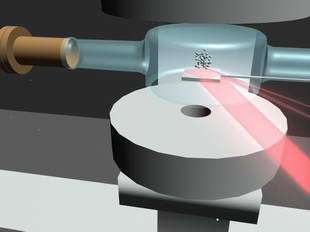
Image: The image depicts an experiment underway at Ohio State University, where physicists are attempting to develop a quantum chip -- a computer chip that uses the quantum mechanical properties of atoms to perform calculations. In the first part of the experiment, lasers and magnetic fields capture vaporized rubidium atoms and form them into a pea-sized cloud. The device holding the cloud then slides down a track to move the atoms into position above a glass chip. Then the magnetic fields are then shut off, releasing the atoms, which fall onto a surface of laser light. (courtesy of Ohio State University)
Worldwide, scientists are racing to develop computers that exploit the quantum mechanical properties of atoms, explained Greg Lafyatis, associate professor of physics at Ohio State . These so-called quantum computers could enable much faster computing than is possible today. One strategy for making quantum computers involves packaging individual atoms on a chip so that laser beams can read quantum data.
Lafyatis and doctoral student Katharina Christandl recently designed a chip with a top surface of laser light that functions as an array of tiny traps, each of which could potentially hold a single atom. The design could enable quantum data to be read the same way CDs are read today.
They described their work in the journal Physical Review A.
Other research teams have created similar arrays, called optical lattices, but those designs present problems that could make them hard to use in practice. Other lattices lock atoms into a multi-layered cube floating in free space. But manipulating atoms in the center of the cube would be difficult.
The Ohio State lattice has a more practical design, with a single layer of atoms grounded just above a glass chip. Each atom could be manipulated directly with a single laser beam.
The lattice forms where two sets of laser beams cross inside a thin transparent coating on the chip. The beams interfere with each other to create a grid of peaks and valleys -- the egg carton-shaped pattern of light.
The physicists expected to see that much when they first modeled their lattice design on computer. But to their surprise, the simulations showed that each valley contained a dark spot, a tiny empty sphere surrounded by electric fields that seemed ideally suited for trapping single atoms and holding them in place, Lafyatis said.
In the laboratory, he and Christandl were able to create an optical lattice of light, though the traps are too tiny to see with the naked eye. The next step is to see if the traps actually work as the model predicts.
“We're pretty sure we can trap atoms -- the first step towards making a quantum memory chip,” Lafyatis said. A working computer based on the design is many years away, though, he cautioned.
In fact, Christandl suspects that they are at least two years away from being able to isolate one atom per trap -- the physical arrangement required for a true quantum memory device.
“Right now, we're just trying to get atoms into the traps, period,” she said.
So far, they've been able to form about a billion gaseous rubidium atoms into a pea-sized cloud with magnetic fields. Now they are working to move that cloud into position above a chip supporting the optical lattice.
Theoretically, if they release the atoms above the chip in just the right way, the atoms will fall into the traps. They hope to be able to perform that final test before Christandl graduates in August.
Should they succeed, the payoff is potentially huge.
Both the government and industry are interested in quantum computing because traditional chips are expected to reach a kind of technological speed limit in a decade or so. When that happens, faster, more powerful computers will require a new kind of hardware.
A “bit” in normal computer chips can only encode data as one of two possibilities: either a one or a zero -- the numbers that make up binary code. But if quantum theorists are correct, quantum bits, or qubits, will enable more efficient problem solving because a qubit can simultaneously encode both a zero and a one. This allows the quantum computer to efficiently carry out a large number of calculations simultaneously.
“In principle, quantum computers would need only 10,000 qubits to outperform today's state-of-the-art computers with billions and billions of regular bits,” Lafyatis said.
Scientists have speculated that qubits could enable long-distance communication and code breaking. But Christandl thinks that the technology could serve an even larger purpose for science in general, by powering computer simulations.
Quantum mechanics tries to explain how atoms and molecules behave at a fundamental level, so simulations of quantum systems could advance research in areas as diverse as astrophysics, genetics, and materials science.
“The quantum computer is the ideal tool for those simulations, because it is a quantum system itself,” Christandl said.
Coauthors on the paper included Jin-Fa Lee, associate professor of electrical engineering, and doctoral student Seung-Cheol Lee of Ohio State's ElectroScience Laboratory.
Source: Ohio State University


