Sapphire Stars in Nanotube Support Role
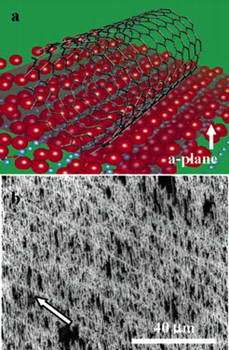
On crystal surfaces, nanotubes self-guide themselves into dense structures with exciting potential applications as sensors or integrated circuits
USC researchers have found that sapphire surfaces spontaneously arrange carbon nanotubes into useful patterns - but only the right surfaces.
Nanotubes are one-atom thick sheets of carbon rolled into seamless cylinders. They can be used to work as chemical sensors and transistors, like devices made from carbon's close chemical cousin, silicon.
Image: Taking the a-plane: Nanotube (mesh) on representation of appropriate crystal surface; below: nanotubes growing on actual surface
As a substrate for the creation of single wall nanotube (SWNT) devices, sapphire has a critical advantage, says Chongwu Zhou of the USC Viterbi School of Engineering's department of electrical engineering.
Single walled carbon nanotubes will grow along certain crystalline orientations on sapphire. No template has to be provided to guide this structuring: it takes place automatically.
Or more accurately, it sometimes happens automatically. With an elegant experiment, Zhou has resolved how and why this occurs. The process is potentially predictable and controllable, opening the door for systematic exploration of sapphire as a SWNT (single walll nanotube) transistor medium.
In a paper accepted by the Journal of the American Chemical Society (V127, P5294, 2005), Zhou says the understanding "may allow registration-free fabrication and integration of nanotube devices by simply patterning source/ drain electrodes at desired locations, as the active material (i.e., nanotubes) is all over the substrate," to build such devices as sensors and integrated circuits for various uses.
According to Zhou, nanotube transistor devices now have to be painstakingly positioned and aligned using methods such as flow alignment and electrical-field-assisted alignment and then individually connected. Experimental techniques can create some more extensive groups of tubes but "it remains difficult to produce planar nanotube arrays over large areas with sufficiently high density and order," Zhou wrote.
Zhou believes exploitation of the properties of sapphire his team investigated may allow production of the right kinds of dense, ordered arrays necessary.
Sapphire is aluminum oxide, also known as the mineral alumina, the abrasive corundum, and when colored by small quantities of iron, ruby. It is readily available as a cheap synthetic.
The crystal is six-sided, rising from a flat base, and has four natural planes on which it can be split to form thin, smooth slices: one parallel to the base, and three other vertical ones. The self-guiding phenomenon was first reported last year by a research team at the Weizman Institute in Israel.
Zhou's team systematically investigated the phenomenon. Certain vertical slices, particularly the a- and r-planes, exhibit the self-guiding nanotube behavior. The c-plane, parallel to the base did not.
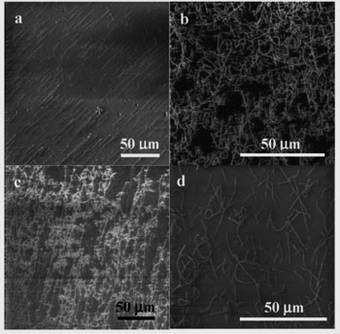
Image: Different strains on different planes. Clockwise from top left, growth on the r, m, c, and a-planes. Note the resulaties on the r- and a-plnaes (upper left). On others, they grow at random. Zhou's research has elucidated understanding and control of the self-guiding property.
According to Zhou, two possibilities might explain the difference. One would be the arrangement of the atoms in the matrix; the other, differences in the "step edge" properties of the surfaces.
Step edges are nanoscopic surface irregularities, minute rises from the suface level.
To eliminate step edges as a possibility, Zhou's group annealed (treated with high, long-lasting heat) samples of both forms, and then tested. Annealing emphasizes step edges, and would accordingly emphasize the arrangement effect, if the effect was dependent on the edges. It did not.
The basal, horizontal slices remained unable to self-guide nanotubes. The two of the vertical slices continued to do so. The behavior seems to be due to the varied arrangement of aluminum and oxygen atoms on the surface. Zhou's team is now investigating how the exact mechanisms at work, in order to further control the process.
Zhou and his team have also, worked with quartz substrates for nanotube synthesis, which did not exhibit any guided growth.
Zhou worked with Xiaolei Liu and Song Han on the research, which was supported by an NSF career Award, an NSF-CENS grant, and an SRC MARCO/ DARPA grant.
Source: University of Southern California


