Organic Materials Spotted in Titan's Atmosphere
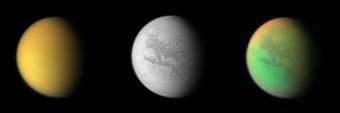
During its closest flyby of Saturn's moon Titan on April 16, the Cassini spacecraft came within 1,027 kilometers (638 miles) of the moon's surface and found that the outer layer of the thick, hazy atmosphere is brimming with complex hydrocarbons.
Image: Three views of Titan, from left to right, natural color, near-infrared and false color. Throughout the Cassini mission, the spacecraft will send more than 300 gigabytes of scientific data back to Earth, which is more than 400 CD-ROMs of information. This data will be examined by more than 250 scientists around the world. Image credit: NASA/JPL/Space Science Institute.
Scientists believe that Titan's atmosphere may be a laboratory for studying the organic chemistry that preceded life and provided the building blocks for life on Earth. The role of the upper atmosphere in this organic "factory" of hydrocarbons is very intriguing to scientists, especially given the large number of different hydrocarbons detected by Cassini during the flyby.
Cassini's ion and neutral mass spectrometer detects charged and neutral particles in the atmosphere. It provides scientists with valuable information from which to infer the structure, dynamics and history of Titan's atmosphere. Complex mixtures of hydrocarbons and carbon-nitrogen compounds were seen throughout the range of masses measured by the Cassini ion and neutral mass spectrometer instrument.
"We are beginning to appreciate the role of the upper atmosphere in the complex carbon cycle that occurs on Titan," said Dr. Hunter Waite, principal investigator of the Cassini ion and neutral mass spectrometer and professor at the University of Michigan, Ann Arbor. "Ultimately, this information from the Saturn system will help us determine the origins of organic matter within the entire solar system."
Hydrocarbons containing as many as seven carbon atoms were observed, as well as nitrogen-containing hydrocarbons (nitriles). Titan's atmosphere is composed primarily of nitrogen, followed by methane, the simplest hydrocarbon. The nitrogen and methane are expected to form complex hydrocarbons in a process induced by sunlight or energetic particles from Saturn's magnetosphere. However, it is surprising to find the plethora of complex hydrocarbon molecules in the upper reaches of the atmosphere. Titan is very cold, and complex hydrocarbons would be expected to condense and rain down to the surface.
"Biology on Earth is the primary source of organic production we are familiar with, but the key question is: what is the ultimate source of the organics in the solar system?" added Waite.
Interstellar clouds produce abundant quantities of organics, which are best viewed as the dust and grains incorporated in comets. This material may have been the source of early organic compounds on Earth from which life formed. Atmospheres of planets and their satellites in the outer solar system, while containing methane and molecular nitrogen, are largely devoid of oxygen. In this non-oxidizing environment under the action of ultraviolet light from the Sun or energetic particle radiation (from Saturn's magnetosphere in this case), these atmospheres can also produce large quantities of organics, and Titan is the prime example in our solar system. This same process is a possible pathway for formation of complex hydrocarbons on early Earth.
This was Cassini's sixth flyby of Titan, but its exploration has just begun. Thirty-nine more flybys of this strange, remote world are planned during Cassini's nominal mission. The next Titan flyby is August 22.
Source: NASA


