MARSIS set to reveal more from Mars
April 29th, 2005 MARSIS

UK scientists stand poised as the European Space Agency's Mars Express spacecraft will start to deploy its MARSIS ground penetrating radar next week (2nd May 2005). Once successfully deployed the radar will start its search for subsurface water reservoirs and studies of the Martian ionosphere.

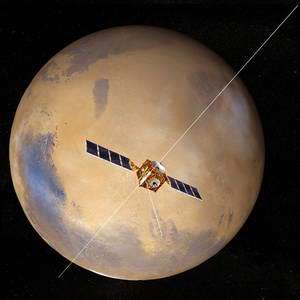
Image: Mars Express in orbit around Mars with the MARSIS antenna unfurled.

The deployment will begin on 2nd May and continue until 12th May by which time the booms will be outstretched to their final position. Each of the two main radar booms, are folded into a box like an accordion. On release the box opens and the elastic energy of the compressed glass fibre booms (40 metres long) allows them to gently unfold - hence the time period over which the deployment happens.

Confirmation of the overall success of the operation will require several days of analysis. Once the deployment is complete, the MARSIS instrument will undergo three weeks of testing before commissioning and start of actual science investigations, just as one of the prime regions of interest for radar observations will come in the right position through the natural evolution of the spacecraft's orbit.

Professor Iwan Williams from Queen Mary University of London, a co-investigator on MARSIS, eagerly awaits data from the instrument, "It will be good to see the booms of MARSIS deployed - better late than never! The deployment is taking place at a time when the conditions are optimised - as the search for sub-surface water can only take place when the pericentre of the orbit is in the dark (or at night). MARSIS will also act as an atmospheric probe and may even be able to detect meteors in the Martian atmosphere."

The deployment of the three MARSIS radar booms is an operation which will take place in three phases, in a window spanning from 2 to 12 May 2005. These operations will be initiated and monitored from ESA's European Space Operations Centre (ESOC) in Darmstadt, Germany. Each boom will be deployed separately, with the two 20-metre 'dipole' booms to be unfurled first and the 7-metre 'monopole' boom to follow a few days later.

The prime objective of MARSIS is to map the distribution of water and ice in the upper portions of the Martian crust. Using techniques similar to oil prospecting on Earth, the instrument will analyse reflections of radio waves in the upper 2-3 km of the Martian crust to reveal the subsurface structure. It will be able to distinguish between dry, frozen and wet soil.

The deployment of MARSIS was originally scheduled to take place in April 2004. However, final computer simulations prior to deployment revealed the possibility of a whiplash effect before they extended to their resting position - with the potential for the booms to hit the spacecraft. This has now been resolved.

The three booms of MARSIS consist of a pair of 20-metre hollow cylinders, each 2.5 centimetres and a 7-metre boom.

Once deployed it is anticipated that MARSIS will continue to probe the subsurface of Mars until at least until the end of November 2005 - and beyond if the mission is further extended.

The principal investigator for MARSIS is Professor Giovanni Picardi from Universita di Roma La Sapienza, Rome, Italy. UK scientists from Imperial College, Queen Mary University of London and Bristol University are involved in investigating the significance of ground water/ice on the Martian surface, data analysis and the detection of sub glacial lakes.

Source: PPARC


print this article email this article download pdf blog this article bookmark this article     Digg this Stumble it share on Facebook share on Reddit add to delicious save to Yahoo! bookmarks
not rated yet


April 29th, 2005 all stories
Space & Earth /

Comments: 0
Rank: not rated yet

  • Stumble this up

  • Digg this

  • Share it:
  • share on Facebook
  • share on MySpace
  • share on Slashdot
  • rss-newsfeed
  • share on Google
  • share on Reddit
  • add to delicious
  • save to Yahoo! bookmarks
  • share on Windows Live
  • Add to Mixx!
Rating: not rated yet

  • Related Stories

  • Mars Express radar collects first surface data
    created Aug 05, 2005 | popularity not rated yet | comments 0
  • Mars Express radar ready to work
    created Jun 22, 2005 | popularity not rated yet | comments 0
  • Smooth deployment for second MARSIS antenna boom
    created Jun 17, 2005 | popularity not rated yet | comments 0
  • Green light for the deployment of the second MARSIS boom
    created Jun 08, 2005 | popularity not rated yet | comments 0
  • Deployment of second MARSIS boom delayed
    created May 09, 2005 | popularity not rated yet | comments 0

Tags


  • Physicists Demonstrate Quantum Memory with Matter Qubits
    Physicists Demonstrate Quantum Memory with Matter Qubits
    Physics / General Physics
    created Jul 03, 2009 | popularity 4.4 / 5 (13) | comments 1
  • 'Holey' Nanosheets for Wastewater Dye Removal
    Nanotechnology / Nanomaterials
    created Jul 01, 2009 | popularity 5 / 5 (5) | comments 1
  • Jellyfish Robot Swims Like its Biological Counterpart
    Jellyfish Robot Swims Like its Biological Counterpart
    Electronics / Robotics
    created Jun 26, 2009 | popularity 4.4 / 5 (7) | comments 1
  • Could Maxwell's Demon Exist in Nanoscale Systems?
    Could Maxwell's Demon Exist in Nanoscale Systems?
    Physics / General Physics
    created Jun 24, 2009 | popularity 4.4 / 5 (18) | comments 29
  • Living Safely with Robots, Beyond Asimov's Laws
    Living Safely with Robots, Beyond Asimov's Laws
    Electronics / Robotics
    created Jun 22, 2009 | popularity 4.6 / 5 (51) | comments 39
  • Other News

    Global warming tactic cools climate but won’t help corals, say researchers

    Space & Earth / Earth Sciences

    created 23 hours ago | popularity 2.3 / 5 (3) | comments 6

    (PhysOrg.com) -- “Geoengineering” experiments proposed to reduce global warming by blocking sunlight with atmosphere-injected particles may cool the world but still leave carbon dioxide levels dangerously high, Stanford scientists ...


    The least sea ice in 800 years

    The least sea ice in 800 years

    Space & Earth / Earth Sciences

    created Jul 01, 2009 | popularity 4.3 / 5 (57) | comments 44

    New research, which reconstructs the extent of ice in the sea between Greenland and Svalbard from the 13th century to the present indicates that there has never been so little sea ice as there is now. The ...


    Gas around young galaxy

    Intense heat killed the Universe's would-be galaxies, researchers say

    Space & Earth / Astronomy

    created Jul 01, 2009 | popularity 3.1 / 5 (18) | comments 23

    (PhysOrg.com) -- Our Milky Way galaxy only survived because it was already immersed in a large clump of dark matter which trapped gases inside it, scientists led by Durham University's Institute for Computational ...


    New class of black holes discovered

    New class of black holes discovered

    Space & Earth / Astronomy

    created Jul 01, 2009 | popularity 4.9 / 5 (18) | comments 15

    A new class of black hole, more than 500 times the mass of the Sun, has been discovered by an international team of astronomers.


    NASA manager pitches a cheaper return-to-moon plan

    Space & Earth / Space Exploration

    created Jun 30, 2009 | popularity 4 / 5 (7) | comments 17

    (AP) -- Like a car salesman pushing a luxury vehicle that the customer no longer can afford, NASA has pulled out of its back pocket a deal for a cheaper ride to the moon.