Carnegie Mellon robot will run time trials to enter $2 million desert race
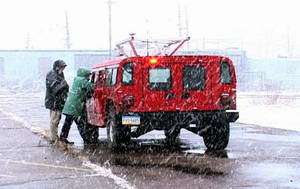
Carnegie Mellon University's H1ghlander robot will demonstrate that it has the skills to compete in the 2005 Grand Challenge, a driverless rumble through 175 miles of hostile desert terrain, including mountains, gullies and dry lakebeds, for a $2-million prize.
The DARPA-sponsored, winner-take-all race will take place on Oct. 8, 2005, but the contestants must prove their worthiness long before that date.
H1ghlander, developed by Carnegie Mellon's Red Team, will be tested by DARPA evaluators in Pittsburgh at the site of the former LTV Steelworks in Hazelwood, from 8:30 to 11 a.m. on May 5. One hundred-eighteen teams are hosting similar evaluations, but only 40 will advance to the next level of competition. H1ghlander is entered in the competition under the auspices of Red Team Too, led collaboratively by Kevin Peterson and Red Whittaker.
Machines are on their own in the Grand Challenge. They must be able to sense and drive autonomously by computing where and how to drive. H1ghlander does it with seven Intel Pentium-M's and a 64-bit Itanium-2 computer housed inside its body. They process terrain models, plan routes and direct H1ghlander's driving to avoid hazards. H1ghlander maps terrain with seven laser range scanners, four stereo cameras and two radar sensors. Some of these are mounted on a gimbal, which operates like an animal's neck to stabilize and point the sensors. The gimbal is a collaborative development with Red Team sponsors HD Systems, Philips and KVH.
H1ghlander will use these combined technologies to run four skill events on May 5 to advance or be eliminated from the race. Race officials will evaluate H1ghlander's performance in three timed 200-meter runs that will test its ability to navigate among waypoints, stay within course boundaries and avoid randomly placed obstacles. A 1,000-meter freestyle run will maneuver an underpass, steer through hairpin curves and follow trails and roads.
H1ghlander is built on a 1999 HUMMER chassis donated by AM General Corp. Electronics from Caterpillar, Inc., control the speed, regulate tire inflation and govern steering. An HD Systems actuator brakes H1ghlander. TTTech controllers regulate the brakes, shift the transmission and shift the transfer case. Caterpillar's MorElectric system generates and distributes power to computers, sensors and actuators. Applanix technology estimates H1ghlander's location by combining inertial, GPS and odometry data.
The ambition of Carnegie Mellon's Red Team is to put two machines on the Grand Challenge starting line and one in the winner's circle. Last year, in the first Grand Challenge, the Red Team entered a Humvee named Sandstorm, which set a record for speed and distance, but did not win the race. Sandstorm is currently practicing in Nevada for its site visit there sometime in May.
The Red Team is sponsored by an alliance that includes Caterpillar, Google and AM General, among many others. The team is united to catalyze new technology, inspire the world and build leaders of tomorrow.
Results of the Pittsburgh site visit will be announced on June 1.
According to Red Team Leader William "Red" Whittaker, "You can't win if you can't start, and you can't start this race just because you want to. Robots have to earn their way to the starting line. Thursday's evaluation is put-up or shut-up."
Spectators are welcome. Gates close at 8:25 a.m.; spectators must arrive by 8:25 and be seated by 8:30 a.m. Due to the nature of the demonstration, visitors are asked to stay through the entire event. Entrance gate location: Drive to the light at the intersection of Hazelwood and Second avenues in Hazelwood. Cross the railroad tracks to prominent parking along the fence. Walk through the gate to the tented grandstand area.
Source: Carnegie Mellon University


