Solar Storms, Arctic Winds Swirl in a Double Dip Cone of Ozone Loss
Solar storms, such as the unusually intense events in October and November 2003, affect many aspects of our lives, such as radio signals and satellite communications. Now a new study partially funded by NASA and using data from several NASA instruments has shown that those late 2003 solar storms, which deposited huge quantities of energetic solar particles into Earth's atmosphere, combined forces with another natural atmospheric process last spring to produce the largest decline ever recorded in upper stratospheric ozone over the Arctic and the northern areas of North America, Europe and Asia.
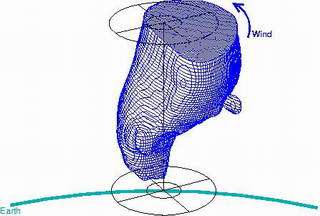
Image: This 3-D image shows the boundary of the Arctic stratospheric polar vortex. Strong winds blowing in the direction of the arrow keep air confined in the vortex. In 2004, the upper part of the vortex (top of image, about 32 miles above Earth) was unusually large and strong. This allowed nitrogen gases that destroy ozone to descend into the stratosphere.
A form of oxygen, ozone protects life on Earth from harmful ultraviolet radiation. The ozone layer has thinned markedly in the high latitudes of the Northern and Southern Hemispheres in recent decades, primarily due to chemical reactions with chlorofluorocarbons and other industrial gases from human activities in the lower stratosphere, about 15 to 20 kilometers (9 to 12 miles) in altitude. Such ozone loss normally occurs only during very cold Arctic winters.
Last spring, however, following a warm Arctic winter, scientists were surprised to see record levels of ozone loss in the upper, not lower, stratosphere; reductions in ozone levels of up to 60 percent about 40 kilometers (25 miles) above Earth's high northern latitudes. This unusual ozone destruction resulted from processes distinctly different from the more commonly observed lower stratospheric ozone loss caused by chemical reactions with chlorofluorocarbons. This time the culprits were high levels of nitrogen oxide and nitrogen dioxide, two gases that together destroy stratospheric ozone. An international team of scientists from the United States, Canada and Europe, including researchers from NASA's Jet Propulsion Laboratory, Pasadena, Calif., and Langley Research Center, Hampton, Va., set out to uncover the processes behind the unexpected ozone loss.
Using data from seven satellites, including NASA's Stratospheric Aerosol and Gas Experiment II and III instruments on the Earth Radiation Budget Satellite and the Halogen Occultation Experiment on NASA's Upper Atmospheric Research Satellite, the researchers concluded the record ozone declines were the result of a combination of unusual stratospheric weather conditions and energetic solar particles in the atmosphere resulting from the vigorous solar storm activity. Results of the study appear in the online version of the American Geophysical Union journal Geophysical Research Letters.
"The 2003-2004 Arctic winter was unique," said Dr. Gloria Manney, a JPL atmospheric scientist and one of the paper's co-authors. "First, the stratospheric polar vortex, a massive low-pressure system that confines air over the Arctic, broke down in a major stratospheric warming that lasted from January to February 2004. Such midwinter warmings typically last only a few days to a week. Then, in February and March 2004, winds in the upper stratospheric polar vortex sped up to their strongest levels on record. The vortex allowed the nitrogen gases, which are believed to have formed at least 10 kilometers (6 miles) above the stratosphere as a result of chemical reactions triggered by energetic solar particles, to descend more easily than normal into the stratosphere."
Study lead author Dr. Cora Randall of the University of Colorado at Boulder's Laboratory for Atmospheric and Space Physics said the phenomenon illustrates the difficulties in separating ozone-destroying atmospheric effects resulting from natural versus human-induced causes. "These findings point out a critical need to better understand the processes occurring in the ozone layer, and demonstrate that scientists searching for signs of ozone recovery need to factor in the atmospheric effects of energetic particles, something they do not now do," she said.
Scientists believe the 1987 Montreal Protocol, an international agreement that phased out production and use of ozone-destroying compounds, may allow the protective ozone layer to recover by the middle of this century. NASA's Aura spacecraft is providing insights into physical and chemical processes that influence the health of the stratospheric ozone layer and climate, producing the most complete suite of chemical measurements ever made.
Manney, lead author of another new paper on Arctic stratospheric interannual variability appearing in the Journal of Geophysical Research, said the findings underscore the incredible complexity of the Arctic region and why more research is necessary.
"While the 2004-2005 Arctic winter has been unusually cold, six of the past seven Arctic winters were unusually warm, with little or no potential for Arctic chemical ozone loss," she said. "This period of warm winters was immediately preceded by a period of unusually cold winters. The point is that it is absolutely critical that we understand how and why the Arctic stratosphere varies from year to year, and that we need to be very careful to consider and account for natural variability when determining trends in atmospheric circulation, temperature, ozone levels and climate change."
Source: JPL NASA


