Mystery Of Nanoparticles Concealed In The Blink Of An Eye
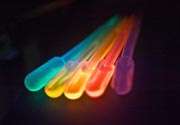
Scientists at the University of Chicago have discovered a better way to measure a confounding property of microscopic high-tech particles called quantum dots. Quantum dots, also called nanocrystals, emit light in a rainbow of colors and are used in lasers, biological studies and other applications, but their tendency to blink hinders their technological value. Imagine the annoyance caused by a randomly flickering light bulb.
“A quantum dot might blink for just a millionth of a second or it might blink for 15 minutes,” said Matthew Pelton, a Research Associate at the University of Chicago’s James Franck Institute. “This is one of the problems we have to solve if we want to engineer the properties of materials, particularly semiconductor materials, on the nanoscale.” Pelton has found a way to measure the blinking that is simpler and faster than the conventional method. He will describe the measurements in the Aug. 2 issue of Applied Physics Letters with co-authors David Grier, now of New York University, and Philippe Guyot-Sionnest of the University of Chicago. Grier compares the light output or “noise” of a blinking group of quantum dots to the babble of a cocktail party conversation. “Even if everyone’s talking about the same thing you probably wouldn’t be able to figure out what they’re saying because they’re all starting their conversations at random times and there are different variations on their conversations,” he said. “Matt has discovered that for these blinking quantum dots, all the conversations are the same in a very special way, and that allows you to figure out an awful lot about what’s being said by listening to the whole crowd.” In previous studies, various research groups combined powerful microscopes with video cameras to record the blinking behavior of one quantum dot at a time, but that method is expensive, time-consuming and difficult to perform. It also required that the dots be placed on a microscope slide. Pelton’s method enables scientists to study the blinking patterns of large quantities of dots. And it can be done in just a few minutes with standard laboratory equipment under a variety of environmental conditions. “Matt’s approach is applicable to situations where previous measurements could not be made,” Guyot-Sionnest said. The four components of Pelton’s system are a light source, a photodetector (a device that measures the intensity of light), an amplifier to boost the photodetector’s output, and an analogue-to-digital converter that translates the amplified output into a string of numbers for digital processing. The system has already revealed new insights into the behavior of quantum dots. Pelton’s results contradict the conventional wisdom about the blinking dots, which states that environmental factors influence the behavior. Pelton made his finding by applying a mathematical tool commonly used by electrical engineers to the problem of blinking quantum dots. “The mathematical tool is almost 200 years old. No one had thought to apply it to this problem before,” Grier said. Studying quantum dots one at a time with microscopes and video cameras was limited by the capabilities of the camera. For example, a camera that takes 40 frames a second would miss any blinks that occur more rapidly. But Pelton’s system includes a tool called a power spectrum to trace blinking behavior. This tool has established numerical recipes for handling the time resolution problem. The research team cannot say how long it might take to crack the mystery of the blinking quantum dots. What is certain is that quantum dots will continue to generate interest in high-tech circles. “Many scientists are trying to start up companies to make nanocrystals and to find a new use for them,” Guyot-Sionnest said. Quantum dot research at the University of Chicago is supported by the Materials Science and Engineering Research Center, the National Science Foundation and the American Chemical Society.
Source: The University of Chicago


