Motorola Debuts First Ever Nano Emissive Flat Screen Display Prototype
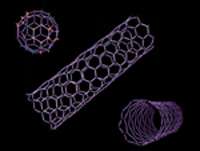
May 9, 2005 Nanotube Fulleren

Building Upon Carbon Nanotube Technology, Motorola Prepares to Revolutionize the Flat Panel Display Industry

Motorola Labs today unveiled a working 5-inch color video display prototype based on proprietary Carbon Nanotube (CNT) technology – a breakthrough technique that could create large, flat panel displays with superior quality, longer lifetimes and lower costs than current offerings. Optimized for a large screen High Definition Television (HDTV) that is less than 1-inch thick, this first-of-its kind NED 5-inch prototype harnesses the power of CNTs to fundamentally change the design and fabrication of flat panel displays.

The development of such a flat panel display is possible due to Motorola Labs Nano Emissive Display (NED) technology, a scalable method of growing CNTs directly on glass to enable an energy efficient design that excels at emitting electrons. Through this cost-effective process and design, Motorola showcases the potential to create longer-lasting NED flat panel displays with high brightness, excellent uniformity and color purity.

“With over 15 years experience and 160 patents in CNT and flat panel displays, we have developed a technology that could enable the next generation of large size flat panel displays to deliver an extraordinary visual experience at a fraction of current prices,” said Jim O’Connor, vice president, Motorola technology incubation and commercialization. “We now look forward to aligning with display manufacturers and enabling them to further this technology and develop commercially available solutions.”

“Motorola’s NED technology is demonstrating full color video with good response time,” said Barry Young, VP and CFO of DisplaySearch, a leading flat panel display market research and consulting company. “And according to a detailed cost model analysis conducted by our firm, we estimate the manufactured cost for a 40-inch NED panel could be under $400.”

Motorola’s proprietary CNT growth process provides excellent precision in designing and manipulating a material at its molecular level – enhancing specific characteristics – and, in the case of flat panel displays, producing high-definition images. The electron emission performance demonstrated by the Motorola technology exceeds that achieved to date with the application of the CNT to the cathode via an organic paste, the process used by other companies.

“Motorola has proven its NED technology to be fully video capable,” said Kimberly Allen, Director Display Technology and Strategy for analyst firm iSuppli. “CNT direct growth on glass appears to have advantages over CNT paste/printing approaches and has potential for larger and more sophisticated displays.”

Motorola’s industry-first working prototype demonstrates:

• Operational full color 5" video section of a 1280 x 720, 16:9, 42-inch HDTV
• High quality brightness
• Bright, vivid colors using standard Cathode Ray Tube (CRT) TV phosphors
• Display panel thickness of 3.3 millimeters (about 1/8th of an inch)
• Low cost display drive electronics (similar to LCD, much lower than Plasma)
• Display characteristics meet or exceed CRTs, such as fast response time, wide
viewing angle, wide operation temperature


print this article email this article download pdf blog this article bookmark this article     Stumble it Digg this share on Facebook retweet share on Reddit add to delicious
Rate this story - 4.2 /5 (32 votes)

Rank Filter

Move the slider to adjust rank threshold, so that you can hide some of the comments.


Display comments: newest first

  • NeilFarbstein - Jul 08, 2008
    • Rank: not rated yet
    Does anyone know if their panels are transparent like LCD screens?
    Contact pron7@att.net

May 9, 2005 all stories

Comments: 1

4.2 /5 (32 votes)
  • Stumble this up

  • Digg this

  • share this

  • hide
  • Related Stories

  • Sony chief executive outlines turnaround plan
    created Nov 19, 2009 | popularity not rated yet | comments 0
  • Retailers Expect a Grinch-like Christmas, Says UB Retail Expert
    created Nov 13, 2009 | popularity not rated yet | comments 0
  • SKorean TV giants tout differing technologies
    created Sep 06, 2009 | popularity not rated yet | comments 0
  • Modified HDTV screens used for 3-D technology (w/ Video)
    created Aug 18, 2009 | popularity not rated yet | comments 0
  • Bringing solar power to the masses
    created Aug 05, 2009 | popularity not rated yet | comments 0


Other News

Nanoparticles used in common household items caused genetic damage in mice

Nanotechnology / Bio & Medicine

created Nov 16, 2009 | popularity 4.7 / 5 (22) | comments 11

Titanium dioxide (TiO2) nanoparticles, found in everything from cosmetics to sunscreen to paint to vitamins, caused systemic genetic damage in mice, according to a comprehensive study conducted by researchers at UCLA's Jonsson ...


Using superconducting probes to get a picture of what it's like inside CNTs

Nanotechnology / Nanophysics

created Nov 20, 2009 | popularity 4.9 / 5 (7) | comments 0

(PhysOrg.com) -- "Carbon nanotubes are exciting for fundamental physics, and for potential technological applications," Nadya Mason tells PhysOrg.com. "However, we are generally limited in the way that we can study them. ...


Nanotube defects equal better energy and storage systems

Nanotube defects equal better energy and storage systems

Nanotechnology / Nanomaterials

created Nov 19, 2009 | popularity 4.4 / 5 (9) | comments 2

(PhysOrg.com) -- Most people would like to be able to charge their cell phones and other personal electronics quickly and not too often. A recent discovery made by UC San Diego engineers could lead to carbon ...


When It Comes to Drug Delivery, Size Matters

Nanotechnology / Bio & Medicine

created Nov 20, 2009 | popularity 5 / 5 (1) | comments 0

(PhysOrg.com) -- One of the great promises of nanotechnologies lies in its ability to create drug-containing nanoparticles decorated with targeting molecules that recognize and bind to cancer cells, providing drug delivery ...


Scientists synthesize graphene-like material: Polymer with honeycomb structure

Scientists synthesize graphene-like material: Polymer with honeycomb structure

Nanotechnology / Nanomaterials

created Nov 19, 2009 | popularity 4.5 / 5 (6) | comments 1

Two-dimensional carbon layers, so-called graphenes, are regarded as a possible substitute for silicon in the semiconductor industry. The electronic properties of these layers can be varied by "building in" ...