Whimpers from the Sun?
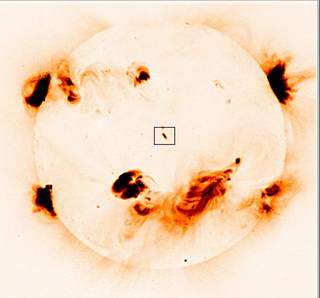
Solar physicists have observed the smallest ever coronal mass ejection (CME) - a type of explosion where plasma from the Sun is thrown out into space, sometimes striking the Earth and damaging orbiting satellites. The observation has come as a great surprise to scientists and has turned previous ideas up-side-down.
Image: A negative image of the Sun showing the active region was taken from Yohkoh data and is provided courtesy of the Solar UK Research Facility. Click on the image to obtain a high resolution version.
To date studies of these phenomena have focussed on large explosions which are easier to detect and which have massive footprints on the Sun, sometimes covering thousands of millions of square miles. But in a paper published in the May edition of Astronomy and Astrophysics, an international team from the UK, Argentina, Finland, France and Hungary showed that CMEs can also be produced from regions as small as the Earth, around 10,000 miles across. This still may sound large but it is tiny by cosmic standards.
CMEs are believed to be caused by the destabilisation of twisted loops in the Sun's magnetic field, which contain lots of energy, settling into more stable positions (like a twisted rubber band unwinding suddenly). Until now, the events have been traced back to large areas of magnetic activity on the Sun, but the new observations relate to an area much smaller than anything seen before. However, even though the event was small it was still energetic enough to reach the Earth and amazingly the magnetic field lines were ten times more twisted than is usually seen in the larger areas.
Understanding CMEs and the mechanisms that power them is important because the plasma and accelerated particles they throw into space can damage satellites, cause harm to astronauts and even affect the Earth itself, causing beautiful aurora but also power black outs and problems to radio signals. This is the science of space weather.
Dr Lucie Green of UCL's Mullard Space Science Laboratory said "Previously coronal mass ejections were thought to be huge, involving massive portions of the Sun's magnetic field and all the theoretical models are based around this assumption. However, this one was amazing in that it came from a tiny magnetic region on the Sun which would normally have been overlooked in the search for CME source regions. This will be an exciting area for further study."
Existing models for CMEs are based on the type of large event previously observed and the team cannot yet say how frequent such mini CMEs are or whether they represent a significant part of space weather. The event was so small that is was almost at the limit of what we can see with current instruments. Future missions studying the Sun will be able to 'see' in much better detail, such as the UK-US-Japanese mission called Solar-B.
The research used data from NASA/ESA's SOHO spacecraft, NASA's TRACE satellite and from the now defunct Japanese/US/UK Yohkoh satellite. UK involvement was funded by PPARC.
The paper appeared in the May edition of the Astronomy and Astrophysics Journal.
Source: PPARC


