Borneo - the most species-rich area in the world!
Scientists map the world for nature conservation
For years, experts have been calling for an improved database that would enable them to develop more effective global nature conservation strategies. Botanists at the University of Bonn have now taken a major step in this direction with the publication, in the Journal of Biogeography, of a world map of plant biodiversity.
The atlas is arranged in 867 zones, known as ecoregions. "This makes the data on the world's plant diversity accessible in accordance with a common geographical standard," explains Gerold Kier, head of the project at Bonn University's Nees Institute for Plant Biodiversity. This work, says Kier, represents a significant advance because the results are needed both for nature conservation planners and those engaged in basic research.
A central innovation here is the breakdown of data by vegetation zone. Tropical rainforests are, unsurprisingly, shown to be among the most species-rich areas on earth. Indeed, Borneo's lowland rainforest is the most diverse of all, with around 10,000 plant species. By comparison, the whole of the Federal Republic of Germany contains some 2,700 different native plants. "However, we have found out for the first time where, within each of the different vegetation zones, plant biodiversity is highest," says Professor Wilhelm Barthlott, founder of the working group and Director of the Nees Institute. It has emerged, for example, that the Sundarbans region (which spreads across Bangladesh and India), the world's most species-rich mangrove area, has not so far been included on many nature conservation priority lists.
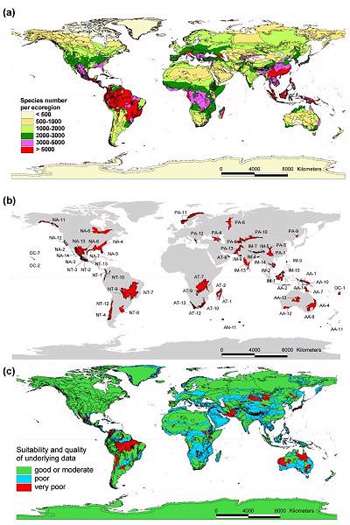
Image: Map a) Vascular plant species per ecoregion. Map b) Ecoregions highest in species richness in each biome within each biogeographical realm. Realms: AA, Australasia; AN, Antarctic; AT, Afrotropics; IM, IndoMalay; NA, Nearctic; NT, Neotropics; OC, Oceania; PA, Palearctic. Biomes: 1 - tropical and subtropical moist broadleaf forests; 2 - tropical and subtropical dry broadleaf forests; 3 - tropical and subtropical coniferous forests; 4 - temperate broadleaf and mixed forests; 5 - temperate conifer forests; 6 - boreal forests/taiga; 7 - tropical and subtropical grasslands, savannas and shrublands; 8 - temperate grasslands, savannas and shrublands; 9 - flooded grasslands and savannas; 10 - montane grasslands and shrublands; 11 - tundra; 12 - mediterranean forests, woodlands and scrub; 13 - deserts and xeric shrublands; 14 - mangroves. Map c) Suitability and quality of underlying plant data at the scale of ecoregions
An important "spin-off" from the project is a map showing how thoroughly the plant world has been studied in different regions. Among the "white patches" on the map, showing areas for which floristic knowledge is very poor, we find the southern Amazon basin and North Colombia, which are two of the world's most biodiverse areas. "There is also little known about the biodiversity that exists in large parts of Pakistan, Afghanistan, Iran, the north of China and, surprisingly, even Japan," adds Kier. Of all the different types of vegetation zone, the flooded savannas and grasslands are the least explored by botanists. Greater efforts are needed in future to discover more about the plant life they contain. The project was conducted as a component of the large-scale BIOLOG-BIOTA programme, funded by German's Federal Ministry of Education and Research (BMBF) and run with the cooperation of the World Wildlife Fund (WWF).


