Probing Question: What is a supersolid?
"Imagine you have an orchestra together, but everyone is playing their own tune, until they begin to follow a conductor. In a normal solid, every atom has its own behavior until very close to absolute zero. Then quantum mechanics takes over and dictates everyone to play the same tune."
That's physics professor Moses Chan's musical metaphor for his discovery that atoms in a solid can condense into what he likes to call "one giant atom," a new phase of matter called a supersolid. Together with post-doctoral associate Eun-Seong Kim, Chan found that when a particular type of helium gas has frozen into a crystal at a fraction of a degree above absolute zero, it exhibits a property only seen before in superfluids: no friction.
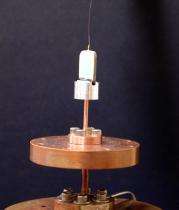
Image: Torsional oscillator used by Moses Chan and Eun-Seong Kim to discover a new phase of matter. Courtesy of Moses Chan
To understand frictionless flow, said Chan, think of a bunch of kids sitting on a spinning merry-go-round. Normally, the more kids on the merry-go-round, the harder it is to stop the movement and reverse its direction. Chan and Kim set up an oscillator that spins back and forth like a merry-go-round shifting direction. They found that helium crystals in a normal solid state behaved as expected, with each additional crystal adding to the mass of the "merry-go-round" and increasing the resistance.
However when those same crystals are frozen below 0.2 degrees Kelvin, something unexpected happens: one percent of the solid helium stops oscillating. "It's as if a portion of the kids on that merry-go-round are sitting on perfectly smooth ball bearings, unaffected by the merry-go-round sliding back and forth underneath them," explained Chan.
Now picture 10 kids on that merry-go-round, and imagine that one has just disappeared mid-spin. This is just the kind of perplexing mystery Chan and Kim encountered when they discovered that the non-oscillating 1.5 percent of solid helium vanished during the experiment. Their clue? The increase in the speed of oscillations. As they cooled the helium to half a degree above absolute zero, the duo observed an increase in speed that typically indicates a loss of mass. (Similarly, a lighter merry-go-round spins faster.) When they heated the helium, the oscillations slowed, suggesting that the missing 1.5 percent of helium had "returned."
Although the possibility of supersolid matter had been discussed for decades, Chan's results still were startling to the physics community. At this moment, there is no single accepted theory to explain how a solid can flow through another solid without mass or friction, but everyone agrees that more experiments are needed.
For now, Chan returns to metaphor to help make sense of it all. Tiny, supercooled helium atoms become very big, even bigger than the space separating the atoms in the crystal, he explained. The atoms are forced to touch each other and overlap, as if everyone in a theater became much bigger than their chairs. The waves of the expanding atoms interact with each other as they overlap. The parts that are in synchrony become enhanced, while conflicting vibrations cancel each other out and disappear. In a moment, the atoms all obtain the same wave function, becoming like one giant atom.
"In classical physics, this cannot happen," he added bemusedly. "If I run into you, there will be a collision, and that will be it, but in quantum mechanics, we become one thing."
Source: Penn State (By Joseph Gyekis)


