Bees equipped with radar solve waggle dance controversy
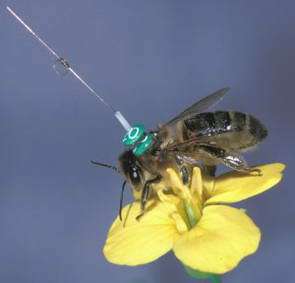
May 14th, 2005 A honeybee equipped with a radar transponder

A paper published in Nature on May 12th provides new data that resolves a long-standing scientific controversy. In the 1960s, Nobel Prize winning zoologist, Karl von Frisch, proposed that honeybees use dance (the "waggle dance") as a coded message to guide other bees to new food sources. However, some scientists did not accept von Frisch’s theory. Using harmonic radar, scientists have now tracked the flight of bees that had attended a "waggle dance" and found that they flew straight to the vicinity of the feeding site, as predicted by von Frisch. The tracks allowed the scientists to determine how accurately bees translate the dance code into successful navigation, and showed that they correct for wind drift even when en route to destinations they have never visited before.

Image: A honeybee equipped with a radar transponder

If a honeybee worker discovers a good feeding site it is believed that she informs her nest mates through a dance that describes the distance and direction of the feeding site. This ‘dance language’ was first described by Karl von Frisch in the 1960s but his experiments also showed that bees that had attended the dance (recruits) took far longer to get to food than would be expected. This time delay caused other scientists to argue that the recruits did not read the abstract code in the dance at all, but found the food source simply by tracking down the smell that they had picked up from the dancing bee. Another suggestion was that recruits simply followed the dancer when she flew back to the food, and then other bees joined in. The controversy has persisted because prior to the advent of harmonic radar, no one could show exactly where the recruits flew when they left their hives.

The scientists watched the waggle dance occurring in a glass observation hive and identified recruits. They captured these recruits as they left the hive, attached a radar transponder to them and then tracked their flight paths using harmonic radar. Most recruited bees undertook a flight path that took them straight to the vicinity of the feeding site where they all spent a lot of time in searching flights, trying to locate its exact position. This searching behaviour accounts for the time lag that caused the original controversy.

In another set of experiments, bee recruits leaving the hive were taken to release sites up to 250m away. These bees flew, not to the feeding site, but in the direction that would have taken them to the feeding site had they not been displaced from the hive. This result add weight to von Frisch’s original theory and allow alternative hypotheses about bee behaviour to be firmly discounted.

Paper: The flight paths of honeybees recruited by the waggle dance' Nature J. R. Riley, U. Greggers, A. D. Smith, D. R. Reynolds & R. Menzel

This article might be of interest as well: Radar tracking reveals that butterflies follow decisive flight paths

Source: Rothamsted Research


print this article email this article download pdf blog this article bookmark this article     Digg this Stumble it share on Facebook share on Reddit add to delicious save to Yahoo! bookmarks
4.1/5 after 9 votes


May 14th, 2005 all stories
Other Sciences /

Comments: 0
Rank: 4.1/5 after 9 votes

  • Stumble this up

  • Digg this

  • Share it:
  • share on Facebook
  • share on MySpace
  • share on Slashdot
  • rss-newsfeed
  • share on Google
  • share on Reddit
  • add to delicious
  • save to Yahoo! bookmarks
  • share on Windows Live
  • Add to Mixx!
Rating: 4.1/5 after 9 votes

  • Related Stories

  • Honey bees on cocaine dance more, changing ideas about the insect brain
    created Dec 23, 2008 | popularity not rated yet | comments 0
  • Deciphering honeybee dances and stock market swings
    created Dec 09, 2008 | popularity not rated yet | comments 0
  • Colonies in collapse: What's causing massive honeybee die-offs?
    created Nov 12, 2008 | popularity not rated yet | comments 0
  • Bumblebees learn the sweet smell of foraging success
    created Oct 24, 2008 | popularity not rated yet | comments 0
  • Honeybee dance breaks down cultural barrier
    created Jun 04, 2008 | popularity not rated yet | comments 0

Tags


  • Physicists Demonstrate Quantum Memory with Matter Qubits
    Physicists Demonstrate Quantum Memory with Matter Qubits
    Physics / General Physics
    created Jul 03, 2009 | popularity 4.4 / 5 (17) | comments 1
  • 'Holey' Nanosheets for Wastewater Dye Removal
    Nanotechnology / Nanomaterials
    created Jul 01, 2009 | popularity 5 / 5 (5) | comments 1
  • Jellyfish Robot Swims Like its Biological Counterpart
    Jellyfish Robot Swims Like its Biological Counterpart
    Electronics / Robotics
    created Jun 26, 2009 | popularity 4.4 / 5 (8) | comments 1
  • Could Maxwell's Demon Exist in Nanoscale Systems?
    Could Maxwell's Demon Exist in Nanoscale Systems?
    Physics / General Physics
    created Jun 24, 2009 | popularity 4.4 / 5 (18) | comments 29
  • Living Safely with Robots, Beyond Asimov's Laws
    Living Safely with Robots, Beyond Asimov's Laws
    Electronics / Robotics
    created Jun 22, 2009 | popularity 4.6 / 5 (52) | comments 40
  • Other News

    Creation Museum president Ken A. Ham

    Paleontologists brought to tears, laughter by Creation Museum

    Other Sciences / Other

    created Jun 30, 2009 | popularity 4.2 / 5 (43) | comments 123

    For a group of paleontologists, a tour of the Creation Museum seemed like a great tongue-in-cheek way to cap off a serious conference.


    Mummified dinosaur skin yields up new secrets

    Mummified dinosaur skin yields up new secrets

    Other Sciences / Archaeology & Fossils

    created Jul 01, 2009 | popularity 4.7 / 5 (15) | comments 10

    (PhysOrg.com) -- Scientists from The University of Manchester have identified preserved organic molecules in the skin of a dinosaur that died around 66-million years ago.


    Liberal? Conservative? Stanford study says mental nudge can make voters flip-flop

    Liberal? Conservative? Stanford study says mental nudge can make voters flip-flop

    Other Sciences / Social Sciences

    created Jul 02, 2009 | popularity 3.8 / 5 (5) | comments 4

    (PhysOrg.com) -- No doubt you’ve worked hard for your success. But chances are you’ve also had some help and lucky breaks along the way.


    Probing Question: How do Ponzi Schemes work?

    Other Sciences / Economics

    created Jul 02, 2009 | popularity 5 / 5 (2) | comments 2

    Imagine the shock, the horror, and the sheer panic that would come with learning that the financial plan you’d sunk your life savings into was a sham, the financial experts you trusted were crooks, and all your money was ...


    Tourists enjoy a "Pineapple Tour" in Costa Rica

    Costa Rica tops happiness, 'green living' poll

    Other Sciences / Social Sciences

    created Jul 04, 2009 | popularity 3 / 5 (3) | comments 0

    Costa Rica is the happiest place on earth, and one of the most environmentally friendly, according to a new survey by a British non-governmental group.