Researchers find way to produce very large diamonds very fast
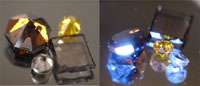
May 16, 2005 Figure 1. The variety of single crystal diamonds produced by the Carnegie high-growth rate CVD process

Washington, D.C. Researchers at the Carnegie Institution's Geophysical Laboratory have learned to produce 10-carat, half-inch thick single-crystal diamonds at rapid growth rates (100 micrometers per hour) using a chemical vapor deposition (CVD) process. This size is approximately five times that of commercially available diamonds produced by the standard high-pressure/high-temperature (HPHT) method and other CVD techniques. In addition, the team has made colorless single-crystal diamonds, transparent from the ultraviolet to infrared wavelengths with their CVD process.

Figure 1. The variety of single crystal diamonds produced by the Carnegie high-growth rate CVD process.

"High-quality crystals over 3 carats are very difficult to produce using the conventional approach," commented Dr. Russell Hemley who leads the diamond effort at Carnegie. "Several groups have begun to grow diamond single crystals by CVD, but large, colorless, and flawless ones remain a challenge. Our fabrication of 10-carat, half-inch, CVD diamonds is a major breakthrough." The results were reported at the 10th International Conference on New Diamond Science and Technology, Tsukuba, Japan, on May 12, and will be reported at the Applied Diamond Congress in Argonne, Illinois, May 18.

Most HPHT synthetic diamond is yellow and most CVD diamond is brown, limiting their optical applications. Colorless diamonds are costly to produce and so far those reported are small. This situation limits general applications of these diamonds as gems, in optics, and in scientific research. Last year, the Carnegie researchers found that HPHT annealing enhances not only the optical properties of some CVD diamond, but also the hardness [1]. Using new techniques, the Carnegie scientists have now produced transparent diamond using a CVD method without HPHT annealing (Fig. 1).
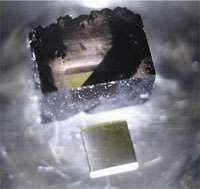
Figure 2. Single-crystal diamond block formed by deposition on 6 {100} faces of a substrate diamond, such as the 4 x 4 x 1.5 mm3

Figure 2. Single-crystal diamond block formed by deposition on 6 {100} faces of a substrate diamond, such as the 4 x 4 x 1.5 mm3 crystal shown below.

To further increase the size of the crystals, the Carnegie researchers grew gem-quality diamonds sequentially on the 6 faces of a substrate diamond plate with the CVD process (Fig. 2). By this method, three-dimensional growth of colorless single-crystal diamond in the inch-range (~300 carat) is achievable.
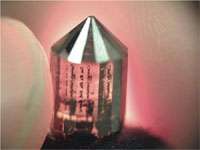
Figure 3. 12 mm (1/2 inch) 5 carat diamond laser cut from a 10 carat single crystal produced by high-growth rate CVD

Figure 3. 12 mm (1/2 inch) 5 carat diamond laser cut from a 10 carat single crystal produced by high-growth rate CVD. The diamond was laser cut (and inscribed) from a diamond block and only partially polished.

Finally, new shapes have been fabricated with the blocks of the CVD single crystals. Figure 3 shows a 12-millimeter anvil that can be used for new types of scientific experiments.

The standard growth rate is 100 micrometers per hour for the Carnegie process, but growth rates in excess of 300 micrometers per hour have been reached, and 1 millimeter per hour may be possible. With the colorless diamond produced at ever higher growth rate and low cost, large blocks of diamond should be available for a variety of applications. "The diamond age is upon us," concluded Hemley.

Source: Carnegie Institution


print this article email this article download pdf blog this article bookmark this article     Stumble it Digg this share on Facebook retweet share on Reddit add to delicious
Rate this story - 3.5 /5 (8 votes)


May 16, 2005 all stories

Comments: 0

3.5 /5 (8 votes)
  • Stumble this up

  • Digg this

  • share this

  • hide
  • Related Stories

  • Bit of bling adds new dimension to laser beam technology
    created Dec 11, 2008 | popularity not rated yet | comments 0
  • New Process Promises Bigger, Better Diamond Crystals
    created Oct 27, 2008 | popularity not rated yet | comments 0
  • Diamonds key to a sparkling listening experience
    created Feb 18, 2005 | popularity not rated yet | comments 0
  • Diamonds May Be the Ultimate MRI Probe, Say Quantum Physicists
    created Sep 22, 2009 | popularity not rated yet | comments 0
  • Diamonds are a laser's best friend
    created Sep 18, 2009 | popularity not rated yet | comments 0


Other News

Climate change could boost incidence of civil war in Africa

Other Sciences / Social Sciences

created 13 hours ago | popularity 2 / 5 (12) | comments 5

Climate change could increase the likelihood of civil war in sub-Saharan Africa by over 50 percent within the next two decades, according to a new study led by a team of researchers at University of California, Berkeley, ...


As robots become more common, Stanford experts consider the legal challenges

Other Sciences / Social Sciences

created 11 hours ago | popularity 4.7 / 5 (3) | comments 0

(PhysOrg.com) -- They already detect and defuse bombs, control traffic patterns and do some basic household chores. And scientists predict that pretty soon, robots will be using artificial intelligence to play a larger role ...


The cause behind the characteristic shape of a long leaf revealed

The cause behind the characteristic shape of a long leaf revealed

Other Sciences / Mathematics

created 13 hours ago | popularity 5 / 5 (2) | comments 0

Applied mathematicians dissected the morphology of the plantain lily (Hosta lancifolia), a characteristic long leaf with a saddle-like arc midsection and closely packed ripples along the edges. The simple ...


Do kids benefit from homework?

Do kids benefit from homework?

Other Sciences / Social Sciences

created 8 hours ago | popularity not rated yet | comments 1

(PhysOrg.com) -- Homework is as old as school itself. Yet the practice is controversial as people debate the benefits or consider the shortcomings and hassles. Research into the topic is often contradictory ...


5-day delivery no sure cure for postal woes, economist says

Other Sciences / Economics

created 9 hours ago | popularity 2 / 5 (1) | comments 0

Scaling back mail delivery from six days a week to five may be the best bet to stem mounting U.S. Postal Service losses, but could still be a gamble, says a University of Illinois economist who has studied the agency's persistent ...