Stegosaur plates and spikes for looks only, researchers say
The bizarre plates and spikes that lined the backbones of the long-extinct stegosaurs were probably extreme examples of the often elaborate and colorful displays developed by animals to recognize fellow members of their species, according to an international team of paleontologists.
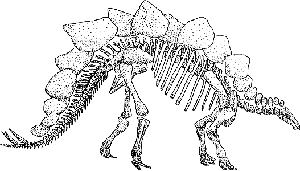
Drawing of a stegosaurus skeleton. (Image courtesy UC Museum of Paleontology)
The team's analysis of stegosaur plates lends support to a growing consensus among paleontologists that the weird adornments of many dinosaurs - the horns of triceratops, the helmet-like domes of the pachycephalosaurs, and the crests of the duck-billed hadrosaurs - likely served no function other than to differentiate species, akin to birds' colorful feather ornamentation.
"Our studies of bone histology are telling us a lot about dinosaur social behavior and lifestyle," said Kevin Padian, professor of integrative biology at the University of California, Berkeley, and a curator in the campus's Museum of Paleontology. "We cut up and compared the internal structures of stegosaur plates and the smaller scutes of their ancestors, and found that a functional explanation for these plates doesn't make sense for all the stegosaurs. So we think that they're more likely involved in some type of species recognition, as with many African antelopes - you have to be different from all animals in the area so you don't get mixed up with other species."
"When people see bizarre structures, they always want to give them bizarre functions," said co-author Russell Main, a former UC Berkeley undergraduate now in graduate school in Harvard University's Department of Organismic and Evolutionary Biology. "But in the case of stegosaurs or even ceratopsians, like triceratops, and also in modern bovids and some other artiodactyls, where you see a number of different types of horn or antler arrangements, you don't necessarily need to apply functional explanations. They can be relatively easily explained by talking about species or mate recognition."
Padian, Main and coauthors John R. Horner of the Museum of the Rockies in Bozeman, Mont., and Armand de Ricqles of the University of Paris report their analysis of dinosaur scutes and stegosaur plates in the spring issue of the journal Paleobiology, to be published later this month.
Stegosaurs were elephantine plant eaters that populated the world during the Jurassic period, about 210 to 144 million years ago, alongside ferocious predators like Allosaurus. Growing up to 20 feet from nose to tip of tail, the most recognized stegosaur, Stegosaurus stenops, had a double row of plates down the back with two or three pairs of spikes on the tail. Other stegosaurs had smaller plates, spikes instead of plates or some other combination. The thin plates and spikes, called scutes, were bony outgrowths of the skin, or osteoderms, and probably were covered with a horny keratin.
Previous paleontologists had proposed that the plates were like the ears of African elephants, designed for heat exchange. They would radiate heat on hot days to cool the animal, or absorb heat from the sun to warm the blood on cool days. Others suggested that they were for protection or for sexual display. In their paper, Padian, Main and their colleagues tend to reject each of these arguments as general explanations.
"These plates wouldn't offer much protection - they consist of a layer of dense bone surrounding a latticework of bone that would be like biting through a sandwich," Padian said. "Plus, we don't see a clear distinction between male and female stegosaurs. Without sexual dimorphism, you have no evidence for sexual selection, so you can't invoke sexual display as an explanation."
As for heat exchange, one major reason earlier scientists proposed such a function for stegosaur plates is that these plates have large blood vessels piercing their interior, perhaps channels to carry blood to be cooled or heated. But it turns out that these "pipes" lead to dead ends, so their roles as major blood vessels are difficult to establish.
To probe the possibility that the plates and spikes were heat exchangers, the paleontologists looked at the evolution of these skin growths in the thyreophoran family, which included the stegosaurs. The team obtained fossils from a half-dozen different species of thyreophorans, ranging from the stegosaurs' earliest ancestors - "armored" dinosaurs that lived 200 million years ago - to the first stegosaurs and related ankylosaurs - which had bony plates or scutes all over their bodies - to the last stegosaurs, which died out in the Early Cretaceous period more than 120 million years ago. All were plant eaters with formidable flat or erect plates on the neck, back and tail. The team sliced through about 10 fossil scutes to study their internal structure.
The earliest thyreophorans, such as the North American dinosaur Scutellosaurus, which measured about four feet from nose to tail, had small bony plates lying flat over their backs and tails, each with a slightly raised keel. These scutes, about a half-inch across, had an internal structure similar in some aspects to the much larger plates of the stegosaurs, yet were obviously useless in regulating the internal temperature of the animal, Main said. The same is true of the later Scelidosaurus, a 13-footer covered with larger scutes with bigger keels; the scutes had the same type of blood vasculature as stegosaur plates and spikes. Ankylosaurs, a sister group to the stegosaurs that survived into the late Cretaceous and went extinct with the rest of the dinosaurs 65 million years ago, had more diverse scutes and ossicles that nevertheless were plumbed in the same way as those on stegosaurs.
Based on this analysis, the team argued that it was unlikely that the larger plates that evolved in the stegosaur ancestors of Scutellosaurus and Scelidosaurus were used for heat exchange.
Padian and Main point out, too, that the horns or antlers of many living animals contain large vessels to supply blood needed for fast growth. None of these horns or antlers function as heat exchangers. A possible role of the large "pipes" in the scutes of stegosaurs and their ancestors was to carry the large blood supply needed for the fast growth that was thought to be typical of dinosaurs.
In addition, not all stegosaurs living at the end of the Jurassic had the big, flat plates of Stegosaurus stenops that most people associate with stegosaurs. Kentrosaurus of Africa and the Asian Huayangosaurus, which were about the same size as Stegosaurus, had mostly spikes with a few "dinky" plates, Main said. These spikes and small plates would have been useless for heat exchange.
"You get quite a large variety in the types of osteoderm arrangements in these animals, but they are not specialized in the way that one would expect if they were built specifically for a thermoregulatory function," he said. "What it looks like is the scutes simply show hypertrophic growth of the keel region, it's simply a modification of an already existing growth pattern."
"There is a natural tendency that leads to elaborate displays for social group recognition, like the calls of birds," Padian said. "This underscores the importance of behavior to evolution."
De Ricqles cautioned, however, that "an accessory role in thermoregulation cannot be ruled out for the Stegosaurus plates. Being so large, well vascularized (and available) they may have been inevitably exapted for such a function. This is so even if the primary explanation of their occurrence in an evolutionary context may be elsewhere: namely in some sort of 'display' (mate or species recognition), as suggested by the comparative, phylogenetic, context of plates development among Stegosauria."
To investigate further whether the elaborate horny displays of stegosaurs and other dinosaurs are involved in sexual displays, Padian is going to South Africa in May and June to measure skulls and bodies of African antelopes to look at the range of sexual dimorphism. Such studies have never been done on a full range of African bovids, he noted. Meanwhile, Main at Harvard is studying bone growth and skeletal mechanics in animals such as goats and emus to see how they change with age.
"We know more about growth in some dinosaurs than we do about growth in large living mammals," Padian said.
The work was supported by the National Science Foundation, the Merck Family Fund, Jim and Bea Taylor, the Charlotte and Walter Kohler Charitable Trust, the Museum of the Rockies, the National Geographic Society and UC Berkeley's Museum of Paleontology. Fossils sliced up by the team came from the University of California Museum of Paleontology, the Museum of the Rockies, London's Natural History Museum, Brigham Young University and the Smithsonian Institution's National Museum of Natural History.
Source: UC Berkeley


