Magnetic sensors - a new slant on an old technology
May 17, 2005 Magnetic Sensors 1

Dr. Paul Robertson and his team are working on a new slant to an old sensing technology. Flux-gate magnetic sensors have been around for many decades and are still used today for tasks such as geological surveys, aerospace instruments and even detecting submarines, as submarines disturb the Earth's magnetic field around them. These devices are usually quite large; assembled from coils wound on to magnetic cores.

Paul and his team have developed new techniques to micro-fabricate flux-gate magnetic sensors, producing tiny versions of these sensors which are:

-- extremely sensitive
-- contained in a miniature package
-- able to work over a wide frequency range

These properties allow the sensors to be used in a range of new applications including the measurement of electrical currents in circuits and the evaluation of the magnetic properties of materials - both of which can be achieved in a non-destructive manner.

One example of this is a magnetic microscope, in which the magnetic sensor is scanned over the surface of an item and the measured magnetic field is displayed as an image on a computer screen. Currently, magnetic microscopes are commercially available which use highly cooled superconducting sensors, but the sensors being developed here in the Department operate at room temperature - resulting in a much lower system cost.

Magnetic Sensors 1
Magnetic Sensors 2
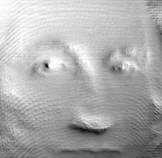
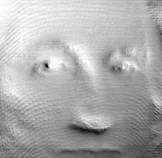
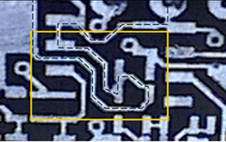
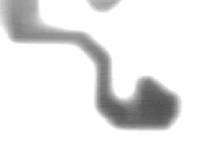
Possible uses for such an instrument include surface defect detection in components and the development of ticketing, security cards, anti-counterfeiting devices and security features on bank notes, as all of these contain magnetic recording material. These pictures show images of current flow around a PCB track and part of George Washington's face - as printed in magnetic ink on a US dollar bill, scanned with a system built in the Department.

Paul and his team are currently developing this technology with a local company for use in a new product - a novel type of current probe for use by electronics engineers. The project is now in the production engineering phase. Other areas of interest would be welcomed.
Magnetic Sensors 3
Magnetic Sensors 3

Source: University of Cambridge


print this article email this article download pdf blog this article bookmark this article     Stumble it Digg this share on Facebook retweet share on Reddit add to delicious
Rate this story - 1.5 /5 (2 votes)


May 17, 2005 all stories

Comments: 0

1.5 /5 (2 votes)
  • Stumble this up

  • Digg this

  • share this

  • hide
  • Related Stories


Other News

Do we need dark matter?

Do we need dark matter?

Physics / General Physics

created 2 hours ago | popularity 2.5 / 5 (2) | comments 9

It's the biggest problem in physics: the matter we can see in the universe accounts for just five per cent of the observed gravity that holds galaxies together.


The LHC tunnel

Peckish bird briefly downs big atom smasher

Physics / General Physics

created Nov 09, 2009 | popularity 4 / 5 (11) | comments 17

A peckish bird briefly knocked out part of the world's biggest atom smasher by causing a chain reaction with a piece of bread, the European Organisation for Nuclear Research (CERN) said Monday.


First Bose-Einstein condensation of strontium

First Bose-Einstein condensation of strontium

Physics / Quantum Physics

created Nov 09, 2009 | popularity 5 / 5 (7) | comments 4

In an international first, scientists from the Institute of Quantum Optics and Quantum Information (IQOQI, Austria) produced a Bose-Einstein condensate of the alkaline-earth element strontium, thus narrowly ...


Quantum gas microscope offers glimpse of quirky ultracold atoms

Quantum gas microscope offers glimpse of quirky ultracold atoms

Physics / Quantum Physics

created Nov 04, 2009 | popularity 4.6 / 5 (19) | comments 4

(PhysOrg.com) -- Physicists at Harvard University have created a quantum gas microscope that can be used to observe single atoms at temperatures so low the particles follow the rules of quantum mechanics, ...


Solving big problems

Solving big problems with new quantum algorithm

Physics / Quantum Physics

created Nov 09, 2009 | popularity 4.5 / 5 (28) | comments 0

(PhysOrg.com) -- In a recently published paper, Aram Harrow at the University of Bristol and colleagues from MIT in the United States have discovered a quantum algorithm that solves large problems much faster ...