Math Says Homeland Security Committee Most Partisan
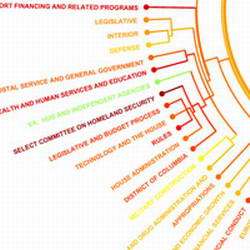
The Select Committee on Homeland Security is one of the most partisan in the U.S. House of Representatives. No, that’s not the latest finding of a Washington think-tank, it’s the results of a new analysis from mathematicians at Georgia Tech. That’s right - I said math.
Image: Researchers arranged committees in a color-coded diagram to illustrate partisanship. Red indicates very partisan while blue represents least partisan. Click here to see full diagram.
The report examines the degree of partisanship and the strength of connections among House committees in the 107th Congress (2001-2002) using network analysis (something like a mathematical version of the six degrees of Kevin Bacon).
Among other findings was that the Homeland Security Committee has very strong ties to the Rules Committee. It has very weak ties to the Permanent Select Committee on Intelligence and shared no members in common with its Terrorism and Homeland Security Subcommittee, which grew out of the bi-partisan group assigned to investigate the 9/11 terrorist attacks. The research is published in this week’s issue of the Proceedings of the National Academy of Sciences.
“We use a tool called network theory, which we borrow from other situations like studies of the World Wide Web or of people who sit together on the boards of more than one company, ” said Mason Porter, visiting assistant professor at Georgia Tech. “By looking at the number of members that pairs of committees and subcommittees share, we were able to determine the strengths of those connections.”
Porter and colleagues studied these relationships in the House from 1989-2004 and provide detailed examples for the 107th Congress. Using a method known as singular value decomposition, they also examined the voting records for each of the 435 members to get an objective indication of how partisan they are.
“Every representative boils down to two numbers that you can put in a rectangle on a piece of paper. One represents how far they are on the extremes of the political spectrum – we called that partisanship – and the other represents how well they play with others,” said Porter.
Current Minority Leader Nancy Pelosi, along with Janice Schakowsky and James McGovern from Illinois were among the most partisan Democrats of the House. Among the most partisan Republicans were Thomas Tancredo from Colorado, John Shadegg from Arizona and Jim Ryun from Kansas. The least partisan members included Frank Lucas from Oklahoma, former congresswoman Constance Morella of Maryland and Ralph Hall from Texas.
The researchers assigned each member a color based on their degree of partisanship (in either party). Red denotes very partisan while blue denotes least partisan with orange, yellow and green falling somewhere in between. They then placed the members in each of their committees and, using the same color system, described the committees based on the average extremism of its members. Arranging the committees around a circular diagram, they drew lines between committees that shared members.
“What the colors do is make certain committees jump out at you,” explained Porter. “That’s how we discovered the strong ties between the Homeland Security Committee and the Rules Committee and how we found the extreme partisanship of both of those groups and the Judiciary Committee.”
“Checking our study against the historical record, our study shows that network theory and singular value decomposition can accurately describe political bodies like the House of Representatives,” said Porter. “Our analysis strongly suggests that committee assignments are indeed stacked, and that some of the most partisan committees share some unusually strong connections considering the differences in their jurisdictions. Our approach suggests that these types of analyses can be very useful to political scientists in the future.”
In addition to Porter, the research team consisted of: Peter J. Mucha, assistant professor of mathematics at Georgia Tech; Mark Newman, associate professor of physics and complex systems at the University of Michigan; and graduate student Casey Warmbrand, from the University of Arizona. The project originated as Warmbrand’s student project when he was an undergraduate at Georgia Tech in 2003. The research is supported by the National Science Foundation’s Vertical Integration of Research and Education program (VIGRE).
Source: Georgia Institute of Technology


