From electronics to photonics; Modulating light with electricity
May 19th, 2005 From electronics to photonics; modulating light with electricity

Much of our electronics could soon be replaced by photonics, in which beams of light flitting through microscopic channels on a silicon chip replace electrons in wires. Photonic chips would carry more data, use less power and work smoothly with fiber-optic communications systems. The trick is to get electronics and photonics to talk to each other.
Now Cornell University researchers have taken a major step forward in bridging this communication gap by developing a silicon device that allows an electrical signal to modulate a beam of light on a micrometer scale.

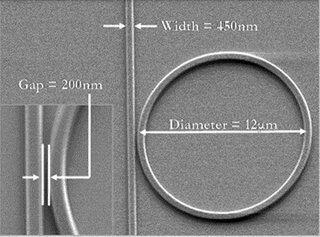
Image: Scanning electron microscope image of the ring coupled to the waveguide with a zoom-in picture of the coupling region. Copyright © Cornell University

Other electro-optical modulators have been built on silicon, but their size is on the order of millimeters, too large for practical use in integrated circuit chips. (a micrometer, or micron, is one millionth of a meter, or one thousandth of a millimeter.) Smaller modulators have been made using compound semiconductors such as gallium arsenide, but silicon is preferable for its ability to be integrated with current microelectronics.

The work is described in a paper published in the May 19, 2005, issue of Nature by Michal Lipson, Cornell assistant professor of electrical and computer engineering, and her research group.

Their modulator uses a ring resonator -- a circular waveguide coupled to a straight waveguide carrying the beam of light to be modulated. Light traveling along the straight waveguide loops many times around the circle before proceeding. The diameter of the circle, an exact multiple of a particular wavelength, determines the wavelength of light permitted to pass. For the experiments reported in Nature, the ring used was 12 microns in diameter to resonate with laser light at a wavelength of 1,576 nanometers, in the near infrared.
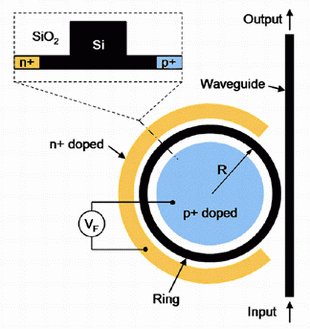
Schematic layout of the ring resonator based modulator. The inset shows a cross-section of the ring

Schematic layout of the ring resonator based modulator. The inset shows a cross-section of the ring. Copyright © Cornell University

The ring is surrounded by an outer ring of negatively doped silicon, and the region inside the ring is positively doped, making the waveguide itself the intrinsic region of a positive-intrinsic-negative (PIN) diode. When a voltage is applied across the junction, electrons and holes are injected into the waveguide, changing its refractive index and its resonant frequency so that it no longer passes light at the same wavelength. As a result, turning the voltage on switches the light beam off.

The PIN structure has been used previously to modulate light in silicon using straight waveguides. But because the change in refractive index that can be caused in silicon is quite small, a very long straight waveguide is needed. Since light travels many times around the ring resonator, the small change has a large effect, making it possible to build a very small device.

In tests, the researchers found that the device could completely interrupt the propagation of light with an applied voltage of less than 0.3 volts. The researchers note in their paper that devices using a PIN configuration have been relatively slow in switching but that the ring resonator configuration also eliminates this problem. Tests using a pulse-modulated electrical signal produced an output with a very similar waveform to the input at up to 1.5 gigabits per second.

The Nature paper is titled "Micrometer-scale Silicon Electro-Optic Modulator." Co-authors are Cornell graduate students Qianfan Xu and Bradley Schmidt and postdoctoral researcher Sameer Pradhan, now at Intel Corp.

Source: Cornell University


print this article email this article download pdf blog this article bookmark this article     Digg this Stumble it share on Facebook share on Reddit add to delicious save to Yahoo! bookmarks
3.5/5 after 11 votes


May 19th, 2005 all stories
Physics / Optics & Photonics

Comments: 0
Rank: 3.5/5 after 11 votes

  • Stumble this up

  • Digg this

  • Share it:
  • share on Facebook
  • share on MySpace
  • share on Slashdot
  • rss-newsfeed
  • share on Google
  • share on Reddit
  • add to delicious
  • save to Yahoo! bookmarks
  • share on Windows Live
  • Add to Mixx!
Rating: 3.5/5 after 11 votes


Tags


  • Transform a ball into a rock -- or make it invisible -- using transformation optics
    Transform a ball into a rock -- or make it invisible -- using transformation optics
    Physics / General Physics
    created 9 hours ago | popularity 3 / 5 (2) | comments 0
  • Could a quantum motor do work?
    Physics / General Physics
    created Jul 07, 2009 | popularity 4 / 5 (12) | comments 0
  • Physicists Demonstrate Quantum Memory with Matter Qubits
    Physicists Demonstrate Quantum Memory with Matter Qubits
    Physics / General Physics
    created Jul 03, 2009 | popularity 4.5 / 5 (20) | comments 1
  • 'Holey' Nanosheets for Wastewater Dye Removal
    Nanotechnology / Nanomaterials
    created Jul 01, 2009 | popularity 5 / 5 (5) | comments 1
  • Jellyfish Robot Swims Like its Biological Counterpart
    Jellyfish Robot Swims Like its Biological Counterpart
    Electronics / Robotics
    created Jun 26, 2009 | popularity 4.4 / 5 (9) | comments 1
  • Other News

    Transform a ball into a rock -- or make it invisible -- using transformation optics

    Transform a ball into a rock -- or make it invisible -- using transformation optics

    Physics / General Physics

    created 9 hours ago | popularity 3 / 5 (2) | comments 0

    (PhysOrg.com) -- Science fiction and fantasy tales are full of the ability to "cloak" characters with invisibility. Whether it is a spaceship with a cloaking device, or a young wizard with an invisibility ...


    Physicists take first step towards super-fast search algorithms for quantum computers

    Physics / General Physics

    created 5 hours ago | popularity 5 / 5 (1) | comments 1

    When you toss a coin, you either get heads or tails. By contrast, things are not so definite at the microcosmic level. An atomic 'coin' can display a superposition of heads and tails when it has been thrown. However, this ...


    Simulations Illuminate Universe's First Twin Stars

    Simulations Illuminate Universe's First Twin Stars (w/ Video)

    Physics / General Physics

    created 3 hours ago | popularity 4 / 5 (1) | comments 0

    (PhysOrg.com) -- The earliest stars in the universe formed not only as individuals, but sometimes also as twins, according to a paper published today in Science Express. By creating robust simulations of the ...


    Physical reality of string theory demonstrated

    Physics / General Physics

    created Jul 06, 2009 | popularity 4.4 / 5 (49) | comments 38

    String theory has come under fire in recent years. Promises have been made that have not been lived up to. Leiden (The Netherlands) theoretical physicists have now for the first time used string theory to describe a physical ...


    UQ researchers break the law -- of physics

    UQ researchers break the law -- of physics

    Physics / General Physics

    created Jul 06, 2009 | popularity 4.6 / 5 (31) | comments 15

    (PhysOrg.com) -- Two UQ Science researchers have proved two famous physical laws that have been widely used for the past 25 years do not always work.