NEMS device detects the mass of a single DNA molecule
Some people are never satisfied. First, nanotechnology researchers at Cornell University built a device so sensitive it could detect the mass of a single bacterium--about 665 femtograms. Then they built one that could sense the presence of a single virus -- about 1.5 femtograms. Now, with a refined technique, they have detected a single DNA molecule, weighing in at 995,000 Daltons -- a shade more than 1 attogram -- and can even count the number of DNA molecules attached to a single receptor by noting the difference in mass.
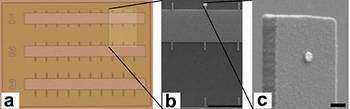
Image: Optical microscope photo (a) shows arrays of cantilevers of varying lengths. (b) Zoomed-in scanning electron microscope (SEM) image of several cantilevers, and (c) Oblique angle SEM image of a single 90nm thick silicon nitride cantilever with a 40 nm circular gold aperture centered 300 nm away from the free end. The scale bar corresponds to 100 nm. Copyright © Cornell University
The devices, which fall in the class of nanoelectromechanical systems (NEMS), could be made even more sensitive through increased miniaturization, the researchers say.
The technology, they suggest, can be combined with microfluidics to perform genetic analysis of very small samples of DNA, even the amount present in a single cell. Current techniques for genetic analysis require small samples of DNA to be replicated many times through a process called PCR amplification. DNA analysis can be used, among other things, to detect genetic markers for cancer susceptibility.
The mass of DNA, proteins and other organic molecules is usually expressed in Daltons. A Dalton, also known as an atomic mass unit, is roughly the mass of a single proton or neutron. In relation to other units of mass, a Dalton is one-thousandth of a zeptogram, which is one-thousandth of an attogram, which is one-thousandth of a femtogram, which is one-thousandth of a picogram, which is one-thousandth of a nanogram, which is a billionth of a gram.
While DNA molecules are fairly large, as molecules go, they are still a step smaller than most viruses, which consist of a DNA core surrounded by a protein coat. The Cornell researchers believe their technology could be used to identify even smaller organic molecules, including proteins, and could have widespread applications in medical and forensic diagnosis.
"The limitation in detecting specific molecules is in the chemistry. The mass resolution of the devices is orders of magnitude better than we're using here," said Harold Craighead, Cornell professor of applied and engineering physics. The ability to identify proteins and other organic molecules could lead to detectors for a variety of diseases, including HIV, he noted.
The latest work is described in a paper by Craighead and co-authors at Cornell and Tel Aviv University, available in the online version of the journal Nano Letters and to be published in a forthcoming issue.
The principle underlying the mass-detection devices is that the frequency at which a solid object vibrates varies with its mass. A big bell rings at a lower tone than a small one. To apply this at the nanoscale, the researchers used the Cornell Nanoscale Facility to create arrays of tiny cantilever oscillators 3 to 5 microns long and 90 nanometers thick on silicon chips -- imagine a diving board that would bounce if you dropped a large bucket of atoms on it. At the end of each cantilever they deposited a tiny dot of gold 40 nanometers in diameter. (A nanometer is one-billionth of a meter, or about the length of three silicon atoms in a row. A micron is 1,000 nanometers.).
A solution containing a strand of DNA consisting of 1,578 base pairs was washed over an array of cantilevers. For experimental purposes, the DNA was modified by the addition of a molecule called a thiol, which contains sulfur atoms that tend to bind to gold. As a result, some of the DNA attached to the gold dots.
When excited by energy from a laser, these cantilevers oscillate at frequencies of around 11 to 12 Megahertz (MHz). The frequency is measured by shining another laser on the oscillator and noting interference patterns in the beam caused by the reflected light. In the reported experiments, the change in mass of 1 attogram was enough to shift the frequency of vibration by 50 Hz or more, depending on the size of the oscillator. With the smallest and most sensitive device, the shift was 194 Hz. This allowed the researchers not only to detect the binding of DNA molecules, but also to count the number of molecules attached to a single receptor by the total frequency shift. By diluting the sample solution, they were able to identify cantilevers to which single DNA molecules had attached.
For DNA analysis or antibody detection, Craighead said, a device could be made with arrays of oscillators each coated with a material that would bind to a different DNA code or antibody shape, and a laser scanning the array would report which oscillators were affected.
In previous work, members of the Craighead Research Group had used a single laser to excite vibrations in nanomechanical oscillators and to measure the resulting vibrations. For these experiments they found they could excite vibrations by shining a laser on a spot nearby on the silicon substrate, while reading results with a second, sharply focused laser scanning the cantilevers. This allowed the use of oscillators of much smaller dimensions, they said. The new technique is described in a separate paper, "Optical excitation of nanoelectromechanical oscillators," published in Applied Physics Letters 86, 193114 (2005).
The Nano Letters paper is titled "Enumeration of DNA molecules bound to a nanomechanical oscillator." Co-authors are graduate students Rob Ilic, Yanou Yang and Rob Reichenbach, postdoctoral researcher Keith Aubin and Slava Krylov, professor in the Department of Solid Mechanics Materials and Systems at Tel Aviv University in Israel.
Source: Cornell University


