One Mars Orbiter Takes First Photos of Other Orbiters
May 19, 2005 One Mars Orbiter Takes First Photos of Other Orbiters

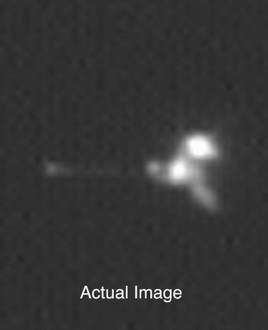
Photographs from NASA's Mars Global Surveyor spacecraft released today are the first pictures ever taken of a spacecraft orbiting a foreign planet by another spacecraft orbiting that planet.

This view is an enlargement of an image of NASA's Mars Odyssey spacecraft taken by the Mars Orbiter Camera aboard NASA's Mars Global Surveyor while the two spacecraft were about 90 kilometers (56 miles) apart.

Mars Global Surveyor has been orbiting Mars since 1997, Mars Odyssey since 2001. Both are managed for NASA by the Jet Propulsion Laboratory, a division of the California Institute of Technology in Pasadena, Calif. Mars Express has been in orbit since late 2003.

Mars Express was passing about 155 miles away when the Mars Orbiter Camera on Mars Global Surveyor photographed it on April 20. The next day, the camera caught Mars Odyssey passing 56 to 84 miles away.

All three spacecraft are moving at almost 7,000 miles per hour, and at 62 miles distance the field-of-view of the Mars Orbiter Camera is only 830 yards across. If timing had been off by only a few seconds, the images would have been blank.

The images were obtained by the Mars Global Surveyor operations teams at Lockheed Martin Space Systems, Denver; JPL and Malin Space Science Systems.

The new images of the European Space Agency's Mars Express and NASA's Mars Odyssey are available on the Internet from NASA at http://www.nasa.gov/vision/universe/solarsystem/mgs-images.html


print this article email this article download pdf blog this article bookmark this article     Stumble it Digg this share on Facebook retweet share on Reddit add to delicious
Rate this story - not rated yet


May 19, 2005 all stories

Comments: 0

not rated yet
  • Stumble this up

  • Digg this

  • share this

  • hide
  • Related Stories

  • A Tale of Planetary Woe (w/ Video)
    created Nov 11, 2009 | popularity not rated yet | comments 0
  • Mars Spacecraft Teams on Alert for Dust-Storm Season
    created Apr 16, 2009 | popularity not rated yet | comments 0
  • Solar Wind Rips Up Martian Atmosphere
    created Nov 21, 2008 | popularity not rated yet | comments 0
  • Gamma-Ray Evidence Suggests Ancient Mars Had Oceans
    created Nov 17, 2008 | popularity not rated yet | comments 0
  • NASA Spacecraft Reveal Largest Crater in Solar System
    created Jun 26, 2008 | popularity not rated yet | comments 0


Other News

Thanksgiving last full day in space for shuttle (AP)

Thanksgiving last full day in space for shuttle

Space & Earth / Space Exploration

created 43 minutes ago | popularity not rated yet | comments 0

(AP) -- Space shuttle Atlantis' astronauts will spend Thanksgiving checking their ship for the ride home.


Russia: no space for space tourists (AP)

Russia: no space for space tourists

Space & Earth / Space Exploration

created 1hour ago | popularity 4 / 5 (1) | comments 0

(AP) -- A top Russian space official says there is no space for tourists wishing to fly to the International Space Station.


Monster Waves on the Sun are Real

Monster Waves on the Sun are Real (w/ Video)

Space & Earth / Astronomy

created 13 hours ago | popularity 4.8 / 5 (12) | comments 1

Sometimes you really can believe your eyes. That's what NASA's STEREO (Solar Terrestrial Relations Observatory) spacecraft are telling researchers about a controversial phenomenon on the sun known as the "solar ...


Cosmic 'dig' reveals vestiges of the Milky Way's building blocks

Cosmic 'Dig' Reveals Vestiges of the Milky Way's Building Blocks

Space & Earth / Astronomy

created 18 hours ago | popularity 4.9 / 5 (15) | comments 1

(PhysOrg.com) -- Peering through the thick dust clouds of our galaxy's "bulge" (the myriads of stars surrounding its center), a team of astronomers has unveiled an unusual mix of stars in the stellar grouping ...


Climate experts debate strategies for reducing atmospheric carbon and future warming

Climate experts debate strategies for reducing atmospheric carbon and future warming

Space & Earth / Environment

created 14 hours ago | popularity 2.6 / 5 (7) | comments 10

(PhysOrg.com) -- Reducing carbon dioxide to safe levels may require extracting carbon from the air, says Cornell climate researcher.