New Primate Discovered in Mountain Forests of Tanzania
"Highland mangabey" is first African monkey to be described in more than two decades
Two research teams working independently in Tanzania have discovered a monkey that had eluded scientists despite decades of research in the region. The "highland mangabey" is the first monkey species to be described in Africa since 1984.
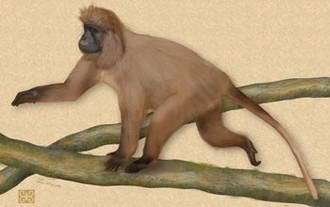
Full-body view of Lophocebus kipunji (Ehardt et al. 2005 sp. nov.). Note the animal's long fur, coat color, lighter area on chest and distal tail and characteristic tail carriage. The artist's reconstruction was drawn from research video taken by C. L. Ehardt in Tanzania in the Ndundulu Forest of the Udzungwa Mountains and in the Southern Highlands. Credit: Zina Deretsky, National Science Foundation
The entire known range for the highland mangabey totals a mere 28 square miles (73 square kilometers). Due to the combined threats of logging, charcoal-making, poaching and excessive removal of forest resources, this rare animal is at great risk of extinction, and the researchers estimate only a few hundred of the monkeys remain.
The co-discoverers--researchers from the Wildlife Conservation Society (WCS), the University of Georgia (UGA) and Conservation International (CI)--describe the mangabey in the May 20, 2005, issue of the journal Science.
With a strange call the researchers describe as a "honk-bark" and dramatic tufts of brown hair sprouting from the sides and top of its head, the new species is not only rare, it is unique.
"To discover a completely new species of monkey in this part of Africa is phenomenal," says UGA primatologist and co-discoverer Carolyn Ehardt. "There is a strong message here: not only is so much of the world's biodiversity severely threatened, but we still do not know what fascinating and important species may be lost before they can be discovered. A finding such as this can only encourage us to redouble our research and conservation efforts," says Ehardt.
Dwelling in the trees of two Tanzanian forests--up to 1.5 miles (2.5 kilometers) above sea level--the highland mangabeys are a hearty lot, enduring temperatures as low as 27° Fahrenheit (-3° Celsius) and seasonal rainfall that can total nearly 8.2 feet (2.5 meters). From field observations and detailed photography, the scientists have concluded that the highland mangabey is a little under 3-feet (1-meter) long--6.5 feet (2-meters) including tail--has long, brown fur, an off-white chest and tail, and black skin. The highland mangabey's arboreal nature and uniformly black face and eyelids are characteristic of one of two mangabey genera, Lophocebus, which is most closely related to baboons.
The species was first discovered by WCS conservation biologists in 2003 during surveys led by Tim Davenport on and around Mt. Rungwe and the Livingstone Forest of the new Kitulo National Park in the Southern Highlands of Tanzania. Hunters from surrounding Wanyakyusa villages had spoken of a shy monkey that they called "kipunji," and the team caught their first glimpse of the monkey that May. The researchers also recorded the monkey's distinctive "honk-bark" - information that proved vital in confirming the species' status.
"The Mt. Rungwe-Livingstone forests have huge biological, economic and cultural value but have been largely left off the conservation map," says Davenport. "It is our hope that this discovery will not only remedy this and help reshape biogeographical thinking, but also demonstrate the urgent need for conservation action across the severely threatened habitats of the Southern Highlands," says Davenport.
Almost 220 miles (350 kilometers) northeast of Mt. Rungwe in the Udzungwa Mountains, researchers from UGA, CI and the Udzungwa Mountains National Park were studying primates independently in the Ndundulu Forest. The expedition was part of Ehardt's NSF-supported research on the conservation and ecology of the critically endangered Sanje mangabey - a relation of the highland monkey but in the genus Cercocebus.
In the 1990s, a team of Danish ornithologists was working in Ndundulu and reported seeing groups of Sanje mangabeys. One of the goals of Ehardt's project was to survey Ndundulu and collect demographic data on those monkeys.
"My concern was that previous visits to Ndundulu had not produced any further sightings of Sanje mangabeys, which raised even more worry about its already dire conservation status," says Ehardt.
In July of 2004, Trevor Jones--then Ehardt's primary field assistant and the lead author on the Science report--made a preliminary visit to Ndundulu. Armed with mapped locations of previous sightings provided by ornithologists Lars Dinesen and Tom Lehmberg, Jones and another field assistant, Richard Laizzer, spotted monkeys for sure, but they were not Sanje mangabeys. Jones and Laizzer assumed the animals were a previously known species of monkey, just not yet reported in Tanzania. It was upon their arrival in Ndundulu that Ehardt and CI's Tom Butynski identified the creatures as a previously unidentified species of mangabey.
"It was therefore out of concern for the critically endangered Sanje mangabey that the project led to the completely unexpected discovery of yet another critically endangered mangabey," says Ehardt. "The Udzungwa Mountains represent an amazing biodiversity 'hotspot,' and this remarkable discovery affirms the region's status as one of the most important for primate conservation in Africa."
Only through the process of preparing the publication on the discovery did Ehardt learn, quite by chance, of Davenport's parallel discovery in the Southern Highlands. The research teams then pooled their observations to craft a more complete picture of the animal, which they have named Lophocebus kipunji in recognition of the local name for the tree-dweller in the Southern Highlands.
"With the discovery of the highland mangabey, the Ndundulu Forest now has three powerful 'flagship species,'" says Butynski. The other two species are birds discovered by the Danish ornithologists: the rufous-winged sunbird discovered in 1981, and the Udzungwa forest partridge, a new genus discovered in 1991.
"The Ndundulu Forest is critical to the long-term survival of all three threatened species. As such, it is imperative that the western boundary of the Udzungwa Mountains National Park be extended westwards to include all of the Ndundulu Forest," he adds.
The researchers have located only 13 highland mangabey groups, three of them in the Ndundulu Forest. This mangabey is one of three threatened monkey species that researchers have identified in the Udzungwas, a testament to the biologically rich but fragile ecosystems of the region.
"Virtually all nonhuman primate species are being pushed to their limits," says Mark Weiss, the NSF program officer who oversees Ehardt's research. "One can only hope that the excitement of new scientific finds such as this one will transmit the need to act to ensure the survival of these animals."
Source: NSF


