Toshiba to Showcase Advances in Sophisticated Home Life Support Robot
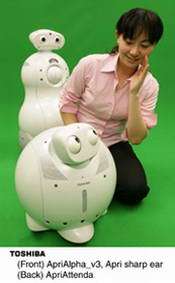
Toshiba Corporation today announced further advances in robotics that take the company closer to its concept of a "life support partner" - a sophisticated robot able to deliver human-centric technologies that provide assistance and support the elderly and young children in the home and in such public places as shopping complexes. One advance enables a robot to distinguish particular voices from among many from multiple directions, and recognize the direction of origin, and interact with the speakers by responding to a repertoire of commands. The other allows a robot to recognize a registered individual and to follow that individual from place to place, even among groups of people.
Toshiba has developed two separate robots to showcase the new technologies and will demonstrate their capabilities at AICHI EXPO's "Prototype Robot Exhibition," at the Morizo and Kiccoro Exhibition Center from June 9 to June 19, 2005.
There is growing interest in the potential of home robots that can care for the aged and young children. Toshiba shares this interest, and is promoting development of human-centric technologies that will realize a "life support partner" able to work naturally and effectively with people in the home and outside, in public places. Such coexistence and interaction requires robots with sophisticated capabilities. Truly effective robots have to be able to recognize multiple individual voices and multiple instructions from different directions at almost the same time. And if they are to be real partners, able to accompany people wherever they go, they have to be able to recognize and follow specific individuals. Toshiba's new robots draw on the company's advanced image and voice recognition technologies to showcase these capabilities.
The robot that can distinguish and recognize voices from any direction, "ApriAlpha _v3," also known as Apri sharp ear, integrates six microphones into its body to assure omnidirectional voice capture. Toshiba's proprietary voice signal processing technology allows the robot to recognize the direction of multiple speakers and what they have said. For example, a robot integrating this technology can respond to a person offering greetings and then go on to respond to a question from another person.
The robot that can accompany people, "ApriAttenda," first of all identifies an individual with its visual sensor and high-speed image processing system by instantaneously recognizing the registered color and texture of the person's clothes. The ability to follow a moving individual requires capabilities going beyond facial recognition. ApriAttenda has to detect and recognize the person and calculate his or her position from a complicated real-life landscape of fixed objects and moving people. Toshiba's new algorithm allows the robot to extract a particular individual from cluttered backgrounds, and to find and reconnect with the person if it loses visual contact.
When the captured subject moves forward, ApriAttenda moves forward. When the person stops, the robot moves to point beside the subject and also stops. ApriAttenda constantly calculates position and the distance to the subject and adjust its speed to maintain a certain distance from the subject. As the subject moves, an integrated ultrasonic sensor checks for obstacles in the robot's way, and the robot negotiates these while maintaining visual contact with the person. If ApriAttenda loses that visual contact, it calls to the person as it searches for and tries to restore the contact.
Toshiba announced its first generation "ApriAlpha" prototype of a life support home robot, in March 2003. ApriAlpha™ could carry out multiple tasks around the home, including control of home appliances, and integrated voice recognition and voice synthesis technologies that allow it to communicate with people in simple conversations. It could also provide such information as news, weather updates and other useful information, and read out e-mail, and also integrated image-recognition technology allowing it to recognize people whose features were recorded to its memory. More important than its built-in functions was ApriAlpha's integration of Open Robot Controller Architecture (ORCA), which enables simple additions of new functions and upgrades of present functions. ORCA allows manufacturers to quickly and easily integrate software developed by third parties into their systems, achieving efficient development of advanced robots. This architecture is also integrated into the new robots.
Both new robots can be configured to provide the life support functions of the original ApriAlpha™ as this prototype, alongside their present capabilities. Toshiba will promote further development of human-centric technologies necessary for a life support home robot; a robot that can accompany people to the shopping complexes and carry things, look after young children and elderly people, and send images to family members outside the home showing what has happened in the home. The company targets commercialization of fully-fledged life support home robot integrating all these capabilities in five or six years time.


