New technique may speed DNA analysis
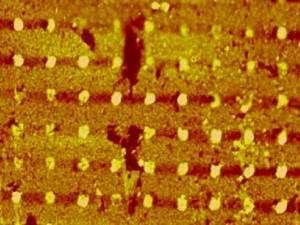
Just as the printing press revolutionized the creation of reading matter, a "nano-printing" technique developed at MIT could enable the mass production of nano-devices currently built one at a time.
These DNA dots, each only about 200 nanometers in diameter, were printed using a new 'nano-printing' technique developed at MIT. Image courtesy / Francesco Stellacci and Arum Amy Yu
The most immediate candidate for this innovation is the DNA microarray, a nano-device used to diagnose and understand genetic illnesses such as Alzheimer's, viral illnesses such as AIDS, and certain types of cancer. The ability to mass produce these complex devices would make DNA analysis as common and inexpensive as blood testing, and thus greatly accelerate efforts to discover the origins of disease.
The demand for ever-shrinking devices of ever-increasing complexity in areas from biomedicine to information technology has spurred several research efforts toward high-resolution, high-throughput nano-printing techniques. Professor Francesco Stellacci and graduate student Arum Amy Yu, both in the Department of Materials Science and Engineering, have developed a printing method that is unmatched in both information content per printing cycle and resolution. They achieved the latter using what Yu calls "nature's most efficient printing technique: the DNA/RNA information transfer."
In the new printing method, called Supramolecular Nano-Stamping (SuNS), single strands of DNA essentially self-assemble upon a surface to duplicate a nano-scale pattern made of their complementary DNA strands. The duplicates are identical to the master and can thus be used as masters themselves. This increases print output exponentially while enabling the reproduction of very complex nano-scale patterns.
One such pattern is found on a DNA microarray, a silicon or glass chip printed with up to 500,000 tiny dots. Each dot comprises multiple DNA molecules of known sequence, i.e. a piece of an individual's genetic code. Scientists use DNA microarrays to discover and analyze a person's DNA or messenger-RNA genetic code. This allows for, say, the early diagnosis of liver cancer, or the prediction of the chances that a couple will produce a child with a genetic disease.
Frequent, widespread use of these devices is hindered by the fact that producing them is a painstaking process that involves at least 400 printing steps and costs approximately $500 per microarray.
MIT's nano-printing method requires only three steps and could reduce the cost of each microarray to under $50. "This would completely revolutionize diagnostics," said Stellacci. With the ability to mass produce these devices and thus make DNA analysis routine, "we could know years in advance of cancer, hepatitis, or Alzheimer's."
Another benefit would be large-scale diagnostics that could provide useful information about disease. Take diabetes. "We don't know if it's genetic. The only way to find out is to test a lot of people," said Stellacci. "The more we test with microarrays, the more we know about illnesses, and the more we can detect them."
SuNS has applications beyond DNA microarrays. Materials both organic and inorganic (metal nanoparticles, for example) can be made to assemble along a pattern composed of DNA strands. This makes SuNS a versatile technology that could be used to produce other complex nano-devices currently manufactured slowly and expensively: micro- and nano-fluidics channels, single-electron transistors, optical biosensors and metallic wires, to name a few.
Stellacci recently received renewed funding from the Deshpande Center for Technological Innovation to continue work on SuNS. The work is also funded by the National Science Foundation.
A version of this article appeared in the May 18, 2005 issue of MIT Tech Talk (Volume 49, Number 28).
Source: MIT (by Lauren J. Clark)


