NASA to put a laser in orbit around the Moon to map its surface
by Patrick L. Barry
Imagine trekking in a lunar rover across miles of the Moon's rough surface. Your mission: to explore a crater with suspected deposits of ice.
In every direction, the gray terrain looks more or less the same. Wouldn't want to get lost in this place! you think to yourself. You arrive where the rover's digital map says the crater should be ... but it's not there!
In a flash, you realize that your map is wrong. The crater's true position must be slightly different. But how different? A kilometer? Ten kilometers? In which direction?
Mission aborted.
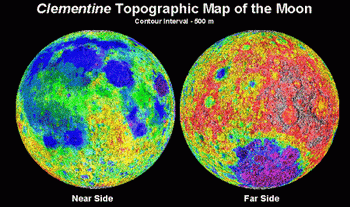
Image: A map of the Moon's surface based on Clementine's laser altimeter. LOLA will produce a far superior 3-D map of the Moon.
The story is fiction, but it raises a real-life issue: the need for accurate maps of the Moon's terrain.
According to NASA's Vision for Space Exploration, astronauts will return to the Moon as early as 2015. This is a key step en route to Mars and beyond. On the Moon, which is practically in Earth's backyard, astronauts can learn how to live on an alien world before attempting longer voyages to other planets.
However, our current maps of the Moon are not very precise. In some areas, near Apollo landing sites, for instance, the locations of craters and ridges are well known. They were extensively photographed by lunar orbiters and Apollo astronauts. But much of the lunar surface is known only approximately.
"If you ask 'where is a crater on the far side of the Moon?', chances are there's probably many kilometers of uncertainty in its true positioning," says David Smith, a scientist at NASA's Goddard Space Flight Center. Even on the near side of the Moon, Smith adds, errors in the true global position of features may be as large as a kilometer.
To improve this situation, NASA plans to send a high-precision laser altimeter to orbit the Moon and create a 3-dimensional map of its surface. When completed, the map will be so accurate that we'll know the contours of the Moon better than we do some remote regions on Earth. Astronauts will be able to use it like a USGS hiking map.
The laser is named "LOLA," short for Lunar Orbiter Laser Altimeter. It's scheduled to launch in 2008 onboard the Lunar Reconnaissance Orbiter spacecraft. LOLA works by bouncing pulses of laser light off the lunar surface as it orbits the Moon. By measuring the time it takes for light to travel to the surface and back, LOLA can calculate the roundtrip distance. LOLA is capable of timing pulses with a precision of 0.6 nanoseconds, corresponding to a distance error of no more than 10 cm.
"In a sense, the Moon is an ideal object for making these kinds of observations because it has no atmosphere to interfere with the propagation of the laser pulses," says Smith, who is the Principal Investigator for LOLA.
LOLA will map the Moon for at least a year, orbiting from the Moon's north pole to the south pole and back every 113 minutes. As it orbits, LOLA will send out laser pulses 28 times per second. Each pulse consists of 5 laser spots in a cross-like pattern spanning about 50 meters of lunar surface. Altogether, LOLA will gather more than 4 billion measurements of the Moon's surface altitude.
After taking into account uncertainties in LOLA's orbit, the overall error in the true elevation of lunar features should be no more than a meter, while the true horizontal locations of those features should be known to within 50 m or less. The next-best laser ranging map, made by the Clementine mission in 1994, had an error of 100 m vertically and a horizontal resolution as coarse as 30 km.
This new map, combined with high-resolution images of the lunar surface taken by a camera onboard the spacecraft, will offer by far the best 3-dimensional model of the Moon ever created.
Uses abound.
"A detailed knowledge of the shape of the Moon, how and where it diverges from a perfect sphere, can tell us a lot about how the Moon formed," notes Smith.
It'll make a great video game, too. Imagine flying around a photorealistic 3-D moonscape, over hills, in and out of craters, around Apollo landing sites. Astronaut training, anyone?
For people actually living on the Moon, LOLA-style maps will be indispensable. Imagine getting caught outside, moonwalking, during a solar flare. Check your LOLA map for the nearest cave: instant shelter. Disoriented by moondust? LOLA has your bearings.
Misplaced a crater? Unimaginable.
Source: Science@NASA (by Patrick L. Barry)


