New Method for Imaging Dec. 26 Indian Ocean Earthquake Yields Unprecedented Results
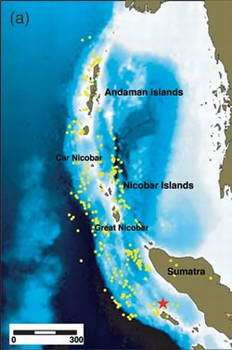
The disastrous Dec. 26, 2004, earthquake in the Indian Ocean that generated an enormous tsunami and led to untold devastation for millions of people was one of the largest earthquakes ever recorded. Seismologists are using new methods to detail the processes that unfolded during the event, known as the Sumatra-Andaman earthquake.
Scientists at Scripps Institution of Oceanography at UCSD, in collaboration with scientists at UCLA, have developed a new method for imaging how the earth ruptured during the quake, which is providing a fresh perspective of the massive event. In this method, the scientists use the first-arriving seismic waves generated by an earthquake to produce detailed images within 30 minutes of an event, a development that could have implications for public-warning and tsunami-alert systems.
The details are described by Scripps’ Miaki Ishii and Peter Shearer and UCLA’s Heidi Houston, professor-in-residence in UCLA’s Earth and Space Sciences department and John Vidale, UCLA professor of Earth and Space Sciences, and interim director of UCLA’s Institute of Geophysics and Planetary Physics, in the May 22 online edition of the journal Nature.
The authors present a method that traces seismic waves back to their original rupture source. In the case of the Sumatra-Andaman event, they used the Japanese Hi-Net array, consisting of about 700 high-quality seismometers, as antennae to track the seismic sources.
“If you were at a pond and dropped a pebble, you would see a ripple appear in the water. If another person only saw the ripple, they could still probably guess where you dropped the pebble by tracing the rings back to the center. That’s exactly what we are doing. We are looking at how the ring of seismic waves is approaching the array to find out where the rupture is occurring,” said Ishii, the Cecil H. and Ida M. Green Scholar at Scripps.
For the Dec. 26 event, the scientists obtained a series of rupture points progressing from south to north in the Sumatra-Andaman region. Called “back projection,” the method is not unlike those used to find sources of oil and gas and by astronomers to image distant galaxies.
“It’s similar to some ideas that have been used in the past, but as far as we know it’s the first time that it has been applied to directly image the rupture of a large earthquake,” said Shearer, a professor in the Cecil H. and Ida M. Green Institute of Geophysics and Planetary Physics at Scripps.
The resulting images from the Sumatra-Andaman event paint a detailed picture (see video animation above right), starting at an epicenter just west of northern Sumatra. A powerful burst of rupture energy is seen 80 seconds later as the quake progresses northwest. A second significant burst occurs after another 220 seconds, west of the Car Nicobar region. The entire event lasts for about eight minutes and ends at the northern Andaman archipelago.
The new findings also show that the event extends father north than initially reported. At 500 seconds and 1,300 kilometers, the Sumatra-Andaman event is longer than the three other largest recorded earthquakes: the 1957 Aleutian earthquake, the 1960 Chile earthquake and the 1964 Alaskan earthquake.
“Our model provides the most detailed view to date of rupture propagation in a great earthquake,” Vidale said.
“The enormous dimensions involved made this event the best candidate in decades for an in-depth look at the rupture and slip in an earthquake,” said Houston.
Because their method capitalizes on an earthquake’s first-arriving seismic energy, called “P waves,” the authors say their model could be implemented in a real-time system in which an accurate estimate of the length and duration of great earthquakes could be obtained within 20 to 30 minutes of the earthquake initiation.
The scientists note that the method’s performance depends on the distance of the seismic array from an earthquake.
“The existing global seismic network could provide enough information to produce useful results for earthquakes anywhere in the world,” said Shearer. “This would give people a much faster idea of the size and extent of large earthquakes. We are trying to work with other scientists to develop ways that they could use this method in a worldwide warning system.”
The study was supported by the Cecil H. and Ida M. Green Foundation and the National Science Foundation.
Source: University of California, San Diego (By Mario Aguilera)


