Nuclear approach may help climate researchers pinpoint volcanic eruptions
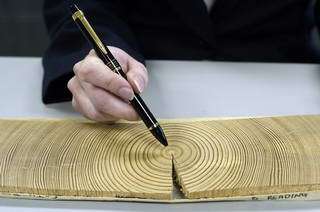
There's gold in them thar rings. Tree rings that is, and Penn State researchers are using the Breazeale Nuclear Reactor to measure gold and link the rings to volcanic eruptions.
"Initially, when we began this work at Cornell University, we were simply looking to see what elements in tree rings could be measured using neutron activation analysis," says Dr. Kenan Unlu, professor of nuclear engineering and associate director for research of Penn State's Radiation Science and Engineering Center. "We can see a lot of elements, but it is easy to see the gold peak."
When Peter I. Kuniholm, professor of archaeology and dendrochronology and director of the Malcolm and Carolyn Wiener Laboratory for Aegean and Near Eastern Dendrochronology at Cornell, saw which tree rings held the highest gold levels, he quickly recognized that they dated to years of known volcanic eruptions.
Because trees add a ring a year to their trunks, if researchers know the cutting date of a tree or can calibrate the tree's rings against a previously dated treeth, researchers can assign each ring accurately to a specific year. By isolated wood from just one ring, neutron activation analysis can measure the gold that the tree took up during that year with parts per billion sensitivity.
Neutron activation analysis uses the neutrons produced by a nuclear reactor to create temporary radioactive isotopes in a sample. Because each isotope has its own gamma radiation signal, the gamma radiation signal strength indicates the amount of that element present.
When Cornell's nuclear reactor at the Ward Center for Nuclear Sciences was shut down, Unlu moved the project, which was funded in part by the National Science Foundation, to Penn State's Breazeale Nuclear Reactor. The preliminary results of analysis of one tree for the years 1411 through 1988 were presented in a recent issue of the Journal of Radioanalytical and Nuclear Chemistry.
Working with Kuniholm and John J. Chiment, another researcher at the dendrochronology laboratory, and Corrnell undergraduate students Pam Sullivan, Meg Underwood and Danielle Hauck, Unlu analyzed 577 rings from a Bosnian or palebark pine from Greece.
"We are looking at the last 500 to 600 years to gain confidence in the procedure," says Unlu. "The volcanic eruptions during that time are known, so we can make correlations. Then we will go back and look at the past 6,000 years."
Six thousand years into the past is the depth of the samples currently at Cornell's dendrochronology laboratory. The lab has already dated approximately 4.5 million tree rings to this time.
The researchers found that they successfully matched gold peaks to volcanic eruptions beginning with an eruption of the Soufriere Hills volcano in 1440 and including a 1480 eruption of Mt. St. Helens. However, the researchers also had high gold peaks for a number of years between 1480 and 1580 when there were no known volcanic eruptions.
"When we see major gold peaks but no volcanoes, it could be forest fires," says Unlu. "We cannot really tell if we are seeing a global signal or a regional or local signal when we are looking at only one tree."
How can a forest fire be confused with a major volcanic eruption? If the researchers are correct, easily. Unlu believes that the increased gold uptake during volcano years occurs because the volcanoes put large amounts of particulate matter into the atmosphere and change the environmental acidity as well as the rainfall, sunshine and temperature patterns creating a stressful situation for trees. The trees, to compensate for a lousy year, try to take up more nutrients, including copper, an essential element for tree growth and health. The gold is indiscriminately absorbed along with the copper, but the copper is used for tree metabolism while the gold remains in the new growth.
Another possible cause of the increased gold uptake could be through the leaves because of direct fallout from the volcanic eruptions, but Unlu believes it is the darkness and stress that push the trees to search for copper among other elements.
To eliminate forest fires and other local events, the researchers want to look at other trees from other areas. They are currently looking at two dated trees from Turkey and one from California.
"The main problem in atmospheric science is they do not have enough data," says Hauck, now a graduate student in nuclear engineering at Penn State. "We want to correlate tree ring data with climate cycles to get a much better indication of what is natural and what is anthropogenic. Tree rings can help."
Large volcanic eruptions put particles into the wind, into the jet stream and have a global, rather than only local effect.
Unlu would also like to go back and check the samples with high gold for other elements. Because neutron activation analysis is nondestructive, and the samples are no longer radioactive after about a month, this reanalysis for other elements is possible. Unlu now has a Nuclear Engineering Education and Research grant from the U.S. Department of Energy to continue his analysis of tree rings and correlation to volcanic activity and other climate events.
Source: Penn State


