Researchers Use Laser To Build Micro-Structures On A Human Hair
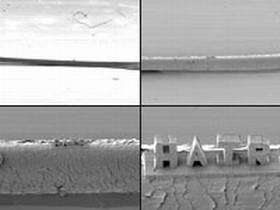
First-ever demonstration has potential applications for cellular and medical research
Researchers in the laboratory of Boston College Chemistry Professor John T. Fourkas have demonstrated the fabrication of microscopic polymeric structures on top of a human hair, without harming it.
Fourkas, in collaboration with Boston College Physics Professor Michael J. Naughton and Professors Malvin C. Teich and Bahaa E. A. Saleh of the Department of Electrical and Computer Engineering at Boston University, used a technique called multiphoton-absorption photopolymerization (MAP), in which a polymer can be deposited at the focal point of a laser beam; scanning of the laser beam in a desired pattern then allows for the formation of intricate, three-dimensional patterns. This technique, also being explored by a handful of other groups worldwide, makes it possible to create features that are 1000 times smaller than the diameter of a human hair.
These new results show for the first time that MAP can be used to fabricate structures nondestructively on biomaterials, and point the way towards applications of MAP in the creation of miniature biodevices, which could include micromanipulators for cells or even individual protein or DNA molecules.
The findings will be published in the June 1 issue of Journal of Applied Physics.
The originial purpose of the study was to demonstrate that intricate and resilient structures could be created with MAP using inexpensive and readily-available materials.
In order to demonstrate the size of the features that could be created, the researchers fabricated structures near a human hair, and in the course of these experiments they discovered that it was also possible to fabricate structures on the hair itself.
"We built the structure on top of the hair with a material that is akin to plexiglass," said Fourkas. "One of the really exciting and unexpected things about this is that we found that we could make this structure on the hair without harming it in any way. This suggests that we could accomplish the same with other biological materials. One could imagine, for instance, building devices directly on skin, blood vessels, and eventually even a living cell. While this idea is currently in the realm of science fiction, our results represent an important step in that direction.
"On the level of individual cells, one can imagine making devices that can tether cells to a surface or to each other, or that allow the delivery of particular chemicals to the cell, or that monitor processes within the cell," said Fourkas. "On a larger scale, if the same sort of structures can be constructed from biocompatible materials one can imagine applications in drug delivery and medical monitoring, among other areas."
Three-dimensional structures created with this technique also have the potential to be used in other miniature devices, such as optical communications hardware: fiber optics and the hardware that is used to interface them with electronics.
"While writing a structure on a hair does not have direct bearing on optical communications," Fourkas said, "on the other hand, we can and have done exactly the same sort of thing on optical fibers that are of comparable size, and this does have direct bearing."
Shown in the image below are electron microscopy images at increasing magnification of a representative structure created on a human hair. The strokes on the letters are more than 20 times smaller than the diameter of the hair. The researchers can readily create structures with features that are more than ten times smaller, which further suggests that it may ultimately prove possible to use this technique to create functional structures directly on single cells.
Source: Boston University (PHOTO CREDIT: Christopher N. LaFratta)


