Double pulsar puts Einstein to the test
June 1, 2005 Double pulsar puts Einstein to the test

Einstein has kept his crown. His general theory of relativity, published in 1916, has stood up to the toughest tests astronomers have so far devised - tests based on a unique pair of pulsars found with CSIROs Parkes telescope in 2003.

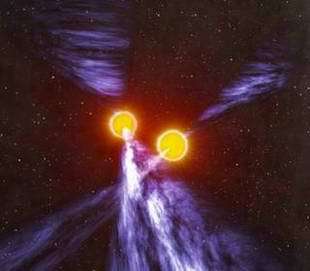
Image: An artist's impression of the double-pulsar system; Image by John Rowe Animations

Dr Ingrid Stairs, an assistant professor at the University of British Columbia in Vancouver, Canada, reported the work by an international team to the American Astronomical Society's meeting in Minneapolis on Monday (30 May).

"This pair of orbiting pulsars, discovered only two years ago, is one of the best laboratories in the Universe for studying the effects of Einstein's general theory of relativity," Dr Stairs said.

Astronomers have been closely tracking this exciting duo with CSIRO's 64m Parkes telescope in central New South Wales, Australia; the US National Science Foundation's 100m Robert C. Byrd Green Bank Telescope in West Virginia, USA and the 76m Lovell telescope at Jodrell Bank Observatory in England.

Because the pulsars orbit each other so quickly - once every 2.4 hours - several general relativity effects are predicted to be large. Four effects were measured within a few months of the pulsars' discovery.

Now the astronomers have measured another significant phenomenon: the stars' orbit is shrinking because the pulsar system is losing energy by emitting gravity waves. At present the shrinkage is tiny - just 7mm a day - but the loss will accelerate in future. And that means the pulsars will collide in 85 million years, the scientists say.

The decay of the orbit is exactly what general relativity predicts.

Other general relativity effects are starting to crop up. One is geodetic precession, the stars wobbling like spinning tops as they move in the curved space-time of their orbit. If this is happening it should result in changes in the observed shapes of the radio pulses, as telescopes on Earth start to see slightly different parts of the irregularly shaped radio beams.

The team already has good evidence for this wobble in the more slowly spinning pulsar. Sensitive observations are now revealing small changes in the beam shape of the other, faster-spinning pulsar.

"More observations will help us work out the full geometry of the system, and test general relativity in even more ways," says team member Dr Dick Manchester of CSIRO.

Links: Details of the pulsar system, called J0737-3039, can be found at http://www.atnf.csiro.au/news/press/double_pulsar/

Source: CSIRO


Rate this story - 5 /5 (1 vote)


June 1, 2005 all stories

Comments: 0

5 /5 (1 vote)

  • hide
  • Related Stories

  • Einstein was right: Unique stellar system provides 'laboratory' for testing relativity
    created Jul 03, 2008 | popularity not rated yet | comments 0
  • Astronomers weigh 'recycled' millisecond pulsar
    created Jan 12, 2006 | popularity not rated yet | comments 0
  • Fermi Telescope Caps First Year With Glimpse of Space-Time (w/ Video)
    created Oct 28, 2009 | popularity not rated yet | comments 0
  • Oddball stars explained
    created Sep 17, 2009 | popularity not rated yet | comments 0
  • Galaxy-Sized Observatory for Gravitational Waves
    created Sep 17, 2009 | popularity not rated yet | comments 0


Other News

As the World Churns

As the World Churns

Space & Earth / Earth Sciences

created 15 hours ago | popularity 4.4 / 5 (12) | comments 17

(PhysOrg.com) -- "Terra firma." It's Latin for "solid Earth." Most of the time, at least from our perspective here on the ground, Earth seems to be just that: solid. Yet the Earth beneath our feet is actually ...


Pressure rises to stop antibiotics in agriculture (AP)

Pressure rises to stop antibiotics in agriculture

Space & Earth / Environment

created 2 hours ago | popularity not rated yet | comments 0

(AP) -- The mystery started the day farmer Russ Kremer got between a jealous boar and a sow in heat.


Voyager makes an interstellar discovery

Voyager makes an interstellar discovery

Space & Earth / Space Exploration

created Dec 26, 2009 | popularity 4.7 / 5 (54) | comments 21

The solar system is passing through an interstellar cloud that physics says should not exist. In the Dec. 24th issue of Nature, a team of scientists reveal how NASA's Voyager spacecraft have solved the mystery.


Climate change puts ecosystems on the run, researchers say

Climate change puts ecosystems on the run, researchers say

Space & Earth / Environment

created Dec 27, 2009 | popularity 2.1 / 5 (14) | comments 26

(PhysOrg.com) -- Global warming is causing habitats to move across the landscape. Can the creatures living there keep up? If they can't, some species may die out, researchers say.


Glider robot a sleek ocean explorer

Space & Earth / Earth Sciences

created Dec 27, 2009 | popularity 4.6 / 5 (10) | comments 2

The sea was heaving, the skies gray. The captain of the research ship was worried about the weather. About 120 miles off the coast of Spain, three Rutgers University scientists had a narrow window of opportunity to find and ...